
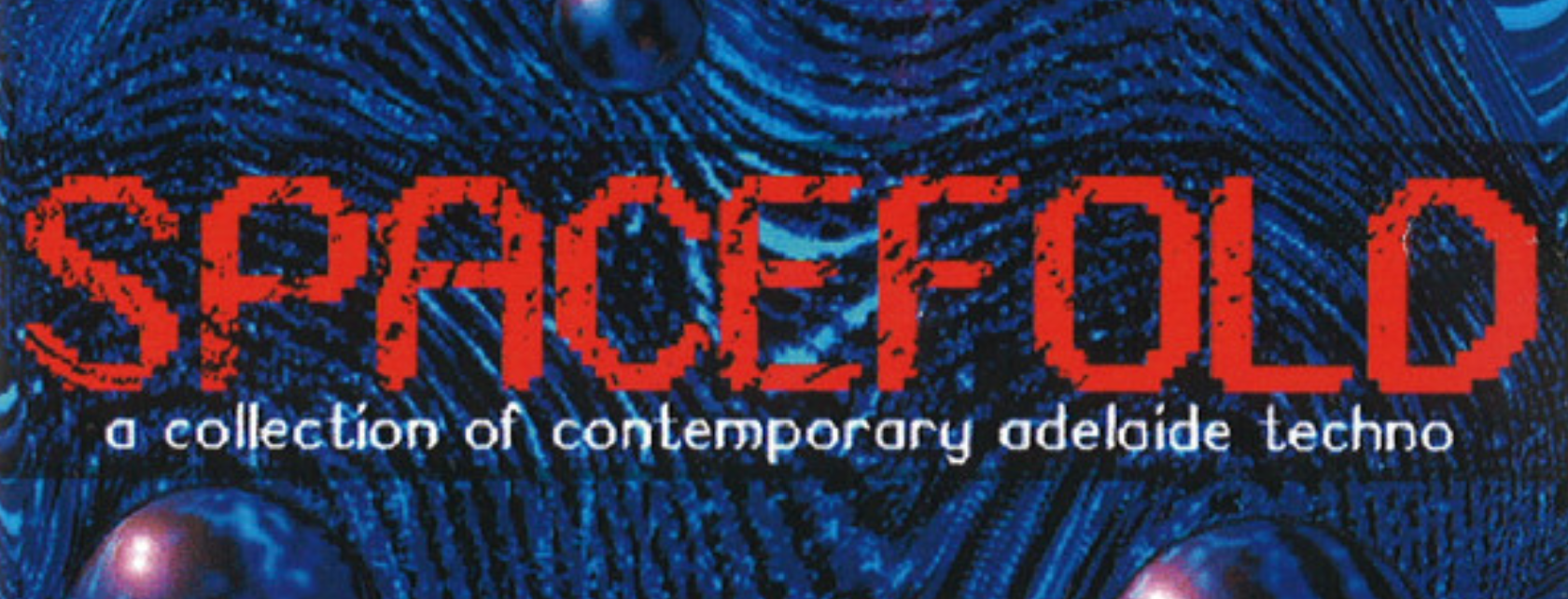
On 12 March 1994, a crowd at Arcadia in Wharf Shed 5, Port Adelaide, celebrated the launch of Spacefold: A Collection Of Contemporary Adelaide Techno. It was a twelve-track CD by five local acts, all of them made in Adelaide by people who were playing clubs and parties every weekend. It came out through Core Magazine and Mindflux, an Adelaide artists’ group, and it was coordinated by Paul Hamon, then one of the three owners of the magazine.
By early 1994, Core Magazine was in its second life. In August 1993, Neo Productions had taken over from the original publishers of The CORE. The new partners were Paul Hamon, Matt Pearce and Tae Won Lee. Pearce became editor, Lee handled the design, and Hamon ran the commercial and administrative side of the business. The magazine already had a record to its name. The previous owners had released The Core EP on Vicious Vinyl in 1993, with a copy of the magazine slipped into every sleeve. Spacefold was the new owners’ turn, and this time the format was CD.
Mindflux brought the visual side. The artists’ group created the artwork for Spacefold, giving the CD a look of its own rather than a generic compilation sleeve. Their involvement also made the release more than a music project. It became a collaboration between the people making the sounds, the magazine covering them and the artists shaping how the scene looked.
The idea was simple. Adelaide had a group of producers and live acts making techno, hardcore and breakbeat on samplers, drum machines and borrowed synths. Their music was heard at raves and on local radio, and much of it lived only on cassette and DAT. A compilation would put that sound into a form people could buy and take home. The practical door opened through DJ PMA, who had access to CD pressing through family connections, which made a small independent run possible. Hamon’s job was to hold it all together: dealing with the artists, collecting tracks, organising the pressing, and planning how the magazine would sell it.
Tracklist
- Mantra, Spacefold (3:06)
- DAMC, Interference (3:47)
- Inner Resonance, Escape Pod (3:18)
- Aquila, Waterfalls (5:57)
- DJ PMA, Future Of The Funk (5:33)
- Inner Resonance, Life Force (4:53)
- DAMC, More Beautiful (6:02)
- Aquila, The Awakening (6:12)
- DJ PMA, In Search Of (6:41)
- Mantra, Jitterbug Heaven (5:20)
- DJ PMA, Brain Collapse (4:42)
- DAMC, Voyager (4:05)
The Artists
The CD opens with Mantra and the title track, Spacefold, a short, sharp introduction at just over three minutes. Mantra returns at track ten with Jitterbug Heaven, one of the longer pieces on the album. The act left almost no other trace in the record books. Spacefold is its only listed release, so these two tracks are its main surviving record.
DAMC was David Anthony McCann, one of the busiest live acts in Adelaide at the time. He performed from 1992 using an Ensoniq EPS sampler, building tracks from old vinyl and film dialogue. Onstage he was often joined by an MC, most often Maestro D. His three contributions, Interference, More Beautiful and Voyager, came from his early catalogue. He played the Arcadia launch himself. McCann moved to Sydney in 1995 but kept flying back to Adelaide to perform, and later reinvented himself as TECHiONE. He played what he said was probably his last DAMC set at Arkaba in April 2016.
Inner Resonance supplied Escape Pod and Life Force, two tracks that sit between the harder cuts and the more atmospheric material. Like Mantra, the act has no other listed release. It does have a place in the memory of the scene: McCann named Inner Resonance among the Adelaide producers and live performers who formed a small community of music makers in the early to mid 90s.
Aquila was Matthew Thomas, and his two tracks, Waterfalls and The Awakening, are among the longest on the CD at around six minutes each. Thomas went on to start his own label, Aerial Recordings, which in 1996 released the Cycle EP and the Ritual EP, both as Aquila. The records were made with support from Juice Records and distributed through IntelliNET Canada. The Ritual EP is now a collector’s item, with copies selling for serious money. He also released music on Psy-Harmonics and Undefined Recordings, and is still working as a sound artist in Adelaide.
DJ PMA was Marc Plummer, the only artist with three tracks besides DAMC: Future Of The Funk, In Search Of and Brain Collapse. In Search Of is the longest track on the album. Plummer already had some reach beyond Adelaide. His track After Burner, first released on the local Jigsaw EP, was licensed to the UK label Rabbit City for its Australian EP. He later recorded as Qume, Sygnosis and Pawn, and all three aliases appear on Undefined Recordings’ 1998 compilation Fringe Dwellers alongside Aquila. That makes it a small reunion of two Spacefold artists four years on. Without his family connection to CD pressing, Spacefold might never have been made.
Promotion and Launch
Once the discs existed, Core Magazine became the marketing department. Hamon ran heavy promotion through the magazine’s pages in the weeks around the release, using the one channel the scene read every issue. The magazine and the CD travelled the same routes: CC Records and a handful of smaller specialist record stores that stocked the music and the people who bought it. The launch at Arcadia brought everyone together. The musicians played, Mindflux took part alongside them, and the release became an event, which suited a scene where parties were how most people discovered new music.
Legacy
Thirty years later, Spacefold has become a collector’s piece. On Discogs, more people want it than own it, and it holds an average rating of 4.83 out of 5. One reviewer advises anyone who sees a copy for sale to buy it. Six of its twelve tracks have been uploaded to YouTube, several by McCann himself. The rest survive only on the original discs.
For the people who made it, Spacefold was a small independent project done with limited money and a lot of goodwill. For Adelaide, it captured a moment when a group of local producers, a street magazine, an artists’ group and a family pressing contact came together to prove the city had a techno sound of its own.
Leave a Reply
You must be logged in to post a comment.