
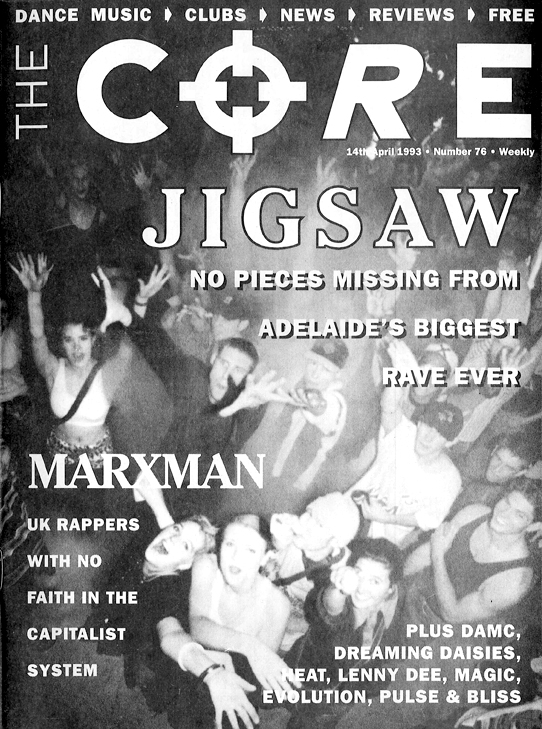
In the vibrant landscape of mid-April 1993, Adelaide’s music scene was a dynamic confluence of massive warehouse raves, a burgeoning class of local electronic producers, and a dense, energetic club circuit. As chronicled in the weekly music publication The Core, the city was alive with sound, from the unifying beats of “Adelaide’s Biggest Rave Ever” to the politically charged rhymes of visiting international artists, painting a picture of a community at a pivotal moment in its cultural evolution.
The Rave Report: Major Events and Reviews
The early 1990s electronic music culture was largely defined by its large-scale rave parties and warehouse events. These gatherings were more than just parties; they were crucial benchmarks for production quality, DJ talent, and the strength of the community. In Adelaide, a series of major events in early April showcased the ambition and diversity of the scene, each leaving a distinct mark on its attendees.
Jigsaw: “Adelaide’s Biggest Rave Ever”
Held at the sprawling Vision Warehouse, the Jigsaw party lived up to its billing, proving to be a landmark event that successfully unified the scene. The night was a testament to meticulous organization and high-calibre talent, featuring a lineup of esteemed local DJs including DJ Adrenalin, PMA, Brendon, Ph.D, and MPK. The production quality was a standout, with impressive video screens creating an immersive visual experience, complemented by two chill-out rooms. Underscoring the night’s sheer intensity, a telling fact emerged: “The crowd consumed all 100 dozen bottles of Evian water within 90 minutes!” Crucially, the event was a powerful showcase for local talent, with the reviewer noting that “the PMA and DAMC’s production skills seemed to be as good as most world-renowned techno producers.” Key figures captured at the event included MC Maestro D, Ben of Instantaneous Productions, Sensi Dancers Justine and Kathy, and MC Scott T.
Heat: The Inflatable Warehouse Party
On Saturday, 10th April, the Heat party offered a different warehouse experience inside an “inflated igloo.” The event was noted for its professional organization, a formidable production featuring Ben Fi’s lighting rig and a huge “Heat” sign in fluorescent tubes, and a crowd that was predominantly male. At the decks, DJ Nigel delivered a set that explored a broad range of garage music, providing a distinct sonic alternative within the weekend’s offerings.
Lenny Dee at The Ark
The following evening, Sunday, 11th April, international DJ Lenny Dee took over The Ark Dance Club for a memorable performance. His set was an exercise in intensity, characterized by the reviewer as “hard, hard, hard; hard and raucous.” Dee’s formidable technical skill was on full display, particularly his aggressive and precise work on the crossfader, which he manipulated with such speed and force that the reviewer noted it was a wonder he didn’t “break the crossfader knob clean off the mixer.”
Magic at Disco
For those seeking an alternative to the relentless pace of hardcore, the Magic event at Disco on Saturday, 10th April, was a “welcome relief.” The club provided a good sound system for DJ Matt Handover’s set, but the night’s most unique feature was a performance artist who took the stage after 11 pm. The act, described as a form of self-mutilation, involved swallowing swords and displaying a pierced tongue, leaving a lasting and visceral impression on the audience.
These large-scale events demonstrated the scene’s capacity for spectacle, but it was producers like David McCann, a key collaborator on tracks played at these very parties, who were forging the unique sound of Adelaide’s underground.
Artist Spotlights: Local Innovators and International Voices
To truly understand the creative forces and philosophies driving a music scene, it is essential to profile the key artists, both local and international, who provide its soundtrack and its substance. In April 1993, Adelaide’s scene was enriched by homegrown talent pushing technical boundaries and by visiting acts bringing a potent political message.
DAMC: Adelaide’s Ascendant Producer
David McCann, known professionally as DAMC or Division By Zero, was a central figure in Adelaide’s burgeoning dance music scene. With a musical background that included playing keyboards for the band Bliss, McCann evolved into a formidable solo producer. His production techniques were innovative, incorporating distortion pedals and guitar effects to forge a unique, hard-edged sound. His collaborative work on “The Core EP” with DJs Jigsaw, Brendon, Angsi, and Uzi further cemented his influence. McCann was a vocal proponent of Adelaide’s local talent, expressing a firm belief in its potential on the global stage: “we can produce stuff here that’s as good as anywhere else in the rest of the world.” Fans had an opportunity to experience his work live during his scheduled performance at The Ark on Wednesday, 21st April.
Marxman: UK Hip Hop with a Political Edge
Bringing an international and overtly political flavour to the scene were Marxman, a UK-based Marxist hip hop group touring their new album, 33 Revolutions Per Minute. Against the backdrop of a post-Thatcher UK, their message was particularly potent. The group’s members—rappers Phrase and Hollis, and DJ Oisin Lunny—traced their origins from Bristol to London, uniting to create music with a powerful message. Their philosophical stance was uncompromising, as stated by Phrase:
Basically we have no faith in the capitalist system.
This worldview permeated their music, with lyrical themes tackling heavy subjects like colonialism and the political situation in Ireland. The story behind their single “All About Eve” was particularly stark, detailing a friend’s violent interrogation by police. The track served as a raw and direct condemnation of state-sanctioned brutality, showcasing the group’s commitment to using hip hop as a vehicle for social and political commentary.
The work of artists like DAMC and Marxman found its audience in the clubs and venues that formed the weekly pulse of the city’s nightlife, providing the crucial platforms where these new sounds could be heard.
The Club Scene: Weekly Lineups and New Venues
The backbone of Adelaide’s music scene was formed by the powerful combination of new venue openings and a packed schedule of regular club nights. This infrastructure fostered a sense of community, provided a consistent platform for DJs and artists, and offered a diverse array of entertainment options for the city’s dedicated followers of dance music.
Grand Opening: The Unlicensed Club Unity
A significant new addition to the landscape was the grand opening of Unity, a newly re-certified unlicensed club set to launch on Saturday, 17th April. Located at 24b Scott Street, the venue featured a two-floor layout designed to cater to different tastes. The ground floor, dubbed ‘Sweaty,’ was dedicated to techno, house, and rap, with a formidable lineup of DJs including Brendon, Nigel, Jell, P.D, and Angsi. Upstairs offered a more relaxed atmosphere with pool tables, a video screen, and a commercial music policy. Operating from 7:30 pm to 12:30 am with an $8 entry fee, Unity was poised to become a new hub for the city’s underground.
Grand Opening: Intense at Synagogue
On the same night, Saturday, April 17th, the Synagogue club launched its new weekly event, ‘Intense.’ Hosted by MC Rodney O, the opening night featured DJs Eezy G, X-Citement, and Brendon & MC Dee, with Glacia & GTB handling duties in the Grooveroom. The club operated with an “invites only” policy from 10 pm to midnight, before opening to the general public from midnight until 7 am. The $7 entry fee, which included the first drink, positioned Intense as a premier late-night destination.
A Tour of Adelaide’s Nightlife
Beyond the grand openings, the weekly schedule was packed with options. A typical week in mid-April offered something for nearly every musical palate. Sundays were for Soul, Funk, and R&B at the Krush Klub at Margaux’s Adelaide Hilton. Thursdays belonged to Rage at the Crystal Empire Parade. Stalwart venues like The Ark, Le Rox, Discovery, and Disco hosted a variety of nights throughout the week.
Reviews of smaller events provided a more granular view of the scene. Unique I at the Synagogue was praised as a “perfect sized venue for the Pulse crowd.” In contrast, the reviewer of Evolution at Disco found the “atmosphere wasn’t very energetic.” A review of Pulse vs Synagogue captured a common frustration, with the reviewer “Kakir” exclaiming, “Why the hell can’t we get a proper dance club that goes to 6am?!?” This sentiment directly echoed broader community anxieties about the scene’s health. Meanwhile, a live performance by Bliss at the Austral Hotel demonstrated how even a simple setup of lights and smoke could effectively transform a pub into a dance venue.
This constant activity on the ground was mirrored by an ongoing conversation in print and on the airwaves, where the scene’s identity, frustrations, and future were passionately debated.
State of the Scene: Media, Commentary, and Community Voice
Media features, radio shows, and audience feedback serve as a critical lens through which to view the health, challenges, and prevailing sentiments of a music scene. In Adelaide, these platforms hosted a vibrant discussion about the direction and durability of the rave and techno cultures.
Defending the Culture: “Rave’s Not Dead!”
An article in The Core directly challenged the narrative that the rave scene was in decline. This defense was bolstered by voices from influential artists. Liam Howlett of The Prodigy was quoted as saying, “That’s a fact. I don’t know what the press are talking about,” dismissing media pessimism. Local luminary DJ Groove Terminator (Dave Carnie) offered a pragmatic analysis, contrasting the value offered by a rave—ten or twelve hours of entertainment—with the higher cost and shorter duration of mainstream rock concerts like U2, arguing that raves provided a more immersive and cost-effective experience.
On the Airwaves: Dreaming Daisies Radio Show
Celebrating its third anniversary, the “Dreaming Daisies” show on Triple M 104.7 stood as Adelaide’s “most underground dance music radio show.” Its host, Georgie Knight, provided sharp commentary on the state of local music. She expressed a sense of concern, noting, “The whole underground techno scene seems to have lost direction.” While Knight lamented that clubs weren’t playing enough new material, she also saw promise on the horizon, specifically praising “two forthcoming Juice EPs, as well as a new Adelaide EP from Greasy Record.” This call for fresh sounds was being answered directly by producers like DAMC, whose innovative techniques represented the very creative resurgence Knight was hoping for.
From the Mailbag: Audience Correspondence
The letters section of The Core provided a direct channel for the community’s voice. A reader identified as Ashley M. echoed the broader debate about the scene’s health, asking, “Why are we trying to convince people that the scene’s declining? All you’re doing is passing the buck!” Another correspondent, BB Science, raised a more industry-specific query: “Why do promoters always crap on about how many frack spots they’ve got?”, suggesting a desire for substance over superficial technical specs.
These local conversations took place within the context of a wider music industry that was constantly evolving, with news from major labels and announcements of major upcoming events.
Industry News and Upcoming Events
Contextualizing the local Adelaide scene within the broader music industry highlights its connection to global trends, while a look at the calendar reveals the exciting events poised to shape its immediate future.
Industry Bulletins
- Deconstruction Records: The UK dance label was enjoying a period of significant chart success, with 12 of its previous 14 single releases reaching the Top-40. The label’s roster included influential artists like Felix, Usura, and M-People.
- William Orbit: The acclaimed British house producer announced the release of a new video cassette titled “Bassomatic and Strange Cargo III,” showcasing his ongoing visual and musical projects.
- Hip Hop News: In the world of hip hop, Ultramagnetic secured a record deal with Wild Pitch, while Nice & Smooth released a new album that featured a collaboration with House Of Pain.
Mark Your Calendar: Future Highlights
- 1993 DMC Championship: The prestigious DJ competition was set to kick off its first heat on Thursday, 22nd April at The Ark Dance Club. A comprehensive panel of esteemed judges—DJ Groove Terminator, DJ Ph.D, DJ James Ingram, Tristan Jones (Central Station Records), Chris Despotakis (Club FM), Stigherrian (The Core), and Kirsty Whicker (The Ark)—was assembled to select a winner.
- Australian Hip Hop Invasion: On Thursday, 15th April, Sydney’s Def Wish Cast and DJ Vame were scheduled to perform at Voices From The Underground at The Old Hindley Cinema complex, bringing a dose of interstate hip hop talent to Adelaide.
- Pulse Presents Unique II: Following their successful first event, Pulse announced Unique II for Wednesday, 21st April at The Ark Dance Club. The night featured DJs PMA, E-zee G, Gravity, and Little Paul, with a production highlighted by the use of the advanced Carl Cox Scan intelligent lighting system.
Leave a Reply