
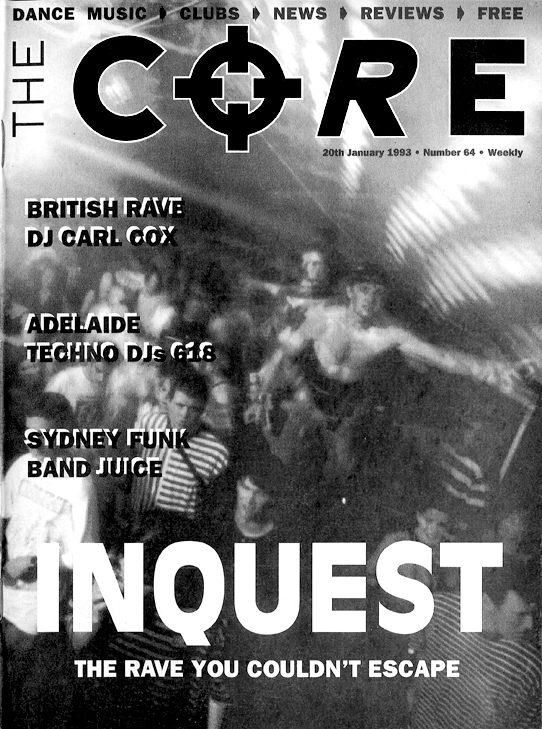
In January of 1993, Adelaide’s electronic music and club scene was a dynamic and self-assured ecosystem, buzzing with activity. It was a culture defined by the significant draw of international headliners, the passionate drive of its thriving local talent, and a diverse landscape of club nights that catered to a wide spectrum of electronic music tastes. From hardcore raves in historic gaols to ambient nights in hotel bars, the city was alive with sound.
International Headliners: The Arrival of Carl Cox
The tour of an internationally recognized DJ serves as a powerful validation for any local music scene, connecting its audience directly to global trends and affirming its place on the world stage. The arrival of England’s Carl Cox in Adelaide was exactly such a moment. His upcoming performance promised to inject a dose of international energy and benchmark-setting technical skill into the heart of the city’s club culture.
Carl Cox was scheduled to perform at the Dance Ar’k Club on Friday, January 29th. Renowned for his trademark three-deck mixing style, Cox stood out as a pioneer. He explained that he was one of the very first DJs to use three turntables not merely for sound effects, but to actively integrate and layer tracks. “It was a bonus to attack and mix three records together,” he stated, “because no-one could knock it.”
His musical philosophy was built on a foundation of crowd engagement and a deep history in dance music. At age 30, with a career stretching back to the late 1970s, he contrasted his approach with that of younger DJs who were “not seeing the roots of where it came from.” For Cox, the modern scene was a natural evolution. “I’ve always been into entertaining people and giving them a good time — after all, they’re paying the money,” he noted, adding that the music of the early 90s was simply an “extension of that.”
This long-term perspective informed his analysis of the evolution of house music. He saw its origins clearly, stating, “When house music came around in ’85 it was like a progression of what disco used to be.” While embracing new sounds, he offered a critical take on the “progressive house” genre, distinguishing between the soulful, garage-influenced American sound and a UK interpretation he felt had become “a bit stale and gropey.” Beyond his solo work, Cox collaborated with his DJ partner, Fantasy, producing the track “Eternal,” which achieved notable success by reaching number 87 on the English charts.
The excitement surrounding a global talent like Carl Cox served to illuminate the strength and enthusiasm of the local artists who formed the scene’s foundation.
The Heart of the City: Adelaide’s Local Scene and Talent
While international acts provide a connection to the global scene, it is the homegrown artists who truly define a city’s unique cultural identity and sound. In January 1993, Adelaide was home to a passionate contingent of DJs and promoters who were not just participating in the scene but actively shaping it with their distinct philosophies and unwavering local pride.
Profile: Adelaide Duo 618
Among the most prominent figures in the local scene were Shift and T-Hai, the DJ duo known as 618. Their musical roots were firmly planted in hip hop and techno, and they held a deep reverence for the origins of the sound, believing that Detroit is the source of “the purest, most real techno.”
Their approach to DJing was a synthesis of raw emotion and technical precision. They emphasized the importance of connecting with the music and reading the crowd, a process that demanded dedication. As T-Hai explained, “You’ve got to be real emotional… you have to ‘prance’ down the station all day just to find this one tune.” This passion translated into their collaborative dynamic, where their individual styles complemented each other to create a cohesive set.
Perhaps most defining was their powerful and positive perspective on their hometown. In their view, Adelaide wasn’t a stepping stone but a destination. They declared unequivocally, “Adelaide is the best city in the whole world.” This sentiment was echoed by both members. “Adelaide is a unique place,” Shift stated, while T-Hai affirmed, “We wouldn’t ever want to move out of it.”
Scene Commentary: The Inquest Rave
This local pride was evident in the grassroots events that animated the city. The “Inquest” rave, held at the historic Old Adelaide Gaol on Saturday, January 15th, featured a lineup of local DJs including Bash, bags, straightjacket, wheelchair, and cell block.
A post-event review captured the raw, unpolished energy of the night, assessing it as a mixed success. While the DJ sets were good, the event was hampered by a late start and an abrupt ending when the crowd spontaneously relocated to the Adelaide Aquatic Centre. The final verdict was that, despite its flaws, it was a “no bullshit type, just a fuckin’ great party.”
However, this event also prompted editorial commentary on the state of the scene. The “Inquest” editor argued that while the party was enjoyable, there was a pressing need for more variety and larger, more ambitious events to prevent stagnation. The commentary posed a critical question to the community: “My question is why is it that the promoters were less ambitious and there were fewer set-ups, fewer things missing off the original line-up, and fewer geeks at the end of the night?”
This blend of passionate local talent and critical self-reflection took place across a network of dedicated venues that formed the scene’s physical backbone.
Venues and Regular Club Nights
The health and diversity of a music scene can be measured by the number and variety of its venues and recurring events. In January 1993, Adelaide offered a comprehensive weekly guide for club-goers, with dedicated nights for nearly every sub-genre of electronic music, from techno and house to funk and ambient.
Dance Ark Club
- Friday: DJs ATB, Brendon, X-citement, Uzi, and MC Rhyme D. Free entry before 10pm.
- Saturday: DJs ATB and Madness.
- Special Events: Hosted Carl Cox on Friday, January 29th. Doors opened at 9pm, $10 entry (free before 10pm).
Heaven (7 West Terrace, Adelaide)
- Event: Rage ‘n’ Rave, held every Thursday night.
- Details: Ran from 9pm till late with free entry before 10pm, specializing in “High Energy Dance Music.”
- Host: DJ HMC with MC Scott ‘n’ Irie.
- Guest DJs: Featured Steve Hopgood on January 21st and Dave Hogg on January 28th.
Astro’s (Hotel Astor, 437 Pulteney Street)
- Monday: Industry Night with DJ Mark D.
- Tuesday: Smart Drinks with DJ Trid Beat Programmers, featuring “healthy smart drinks” and an “ambient atmosphere.” Free entry.
- Wednesday: Beyond with DJs 6Jk and T-Hai, playing techno and house.
- Thursday: Re-Lax with DJs JK & P. Voy, playing jazz-influenced house and garage. Entry is $3.
- Friday: Rubber with DJ Nigel.
- Saturday: Funk/Garage/Soul with DJ Soul.
- Sunday: Re-Lax with DJ Mark, with a $3 entry fee.
Le Rox
- Event Series: The Final Waterfall.
- Details: This series showcased a cycle of different styles, curated by Azulia and Matt Thomas. A special guest from Central Station Records appeared on Wednesday, January 20th.
- Status: The venue was noted as being temporarily closed for renovations.
Other Notable Venues and Nights
- The Lion Arts Centre: Hosted “Hardcore Central” on Saturday, January 23rd, with a massive lineup including DJs Brendon, MPK, X-Zee-N, Ezee-G, SFI, DT, Ecitente, and guests.
- The Lion Arts Centre: Also on Saturday, January 23rd, the venue hosted the “Headstrong!” night.
- The Zoo: Thursdays featured the “Global” night with HMC, Nigel, and guests, running Strongbow promotions.
- Disco City Mission Hall (69 Light Square): Hosted “wednesday inferno” with pVoy and HMC, “friday t.g.i.f.” with major move and angelo, and “saturday fever” with groove terminator and hmc.
- The Synagogue Place: Hosted Driller & Mark on Fridays and a Saturday event with Mix Masters, X-citement, E-Zee-G, and Nigel.
Beyond these regular weekly fixtures, a series of one-off events and special performances gave the month its unique character.
January 1993 Special Events Calendar
Beyond the weekly club schedule, several unique events highlighted the dynamism and key moments of transition within Adelaide’s music culture during this period.
21st Century A.D.
- Date: Thursday, January 21st
- Venue: The Old Union Complex
- Performance: The event marked the last Australian performance of Adelaide’s No.1 Techno System, The System A.D.
- Support Acts: A strong local lineup featured DJs pHd, Angus, Brendon, Uzi (HUGH-Z), X-citement, Mindflux, and Aquila.
Flashing’ At Disco
- Date: Sunday, January 24th (Australia Day long weekend)
- Details: This long weekend special featured local stalwarts DJs HMC and Groove Terminator, who were joined by Sydney’s vinyl supremo Pee Wee Ferris.
The Final Waterfall
- Date: Wednesday, January 20th
- Venue: Le Rox
- Details: As part of a new series exploring different electronic music styles, this night featured a special guest from the influential Central Station Records. The event was curated with the help of Azulia and Matt Thomas.
DMC DJ Championships
- Announcement: It was announced that the prestigious DMC DJ Championships were coming to Adelaide. The call went out to aspiring local talent to “battle it out down in Adelaide.” To promote the competition, a special DMC DJ Tape was made available, featuring tracks from artists including “Techno Legend ‘Moby’.”
These local happenings were complemented by news and releases from the broader music industry, which provided the soundtrack for the city’s dancefloors.
Music Industry News and Releases
Adelaide’s local scene did not exist in a vacuum; it was deeply connected to and influenced by national and international music trends. Key industry news, record releases, and developing commentary provided context and new material for the city’s DJs and fans.
Global Music News
- Spiritual High: The group’s “Moodswings” LP found significant success in the United States, selling 100,000 copies even without a hit single. The track was also remixed by Well Hung Parliament.
- Shara: The vocalist from Bizarre Inc announced she was going solo. Her debut album, “Slam,” was slated for release on the deConstruction label and was co-written and produced by Mike Pickering and Adam Sherwood.
- Dance for Somalia: A fundraising single, a cover of “Like A Prayer” written by Salt-N-Pepa, was performed by L.A. Reid, Pebbles, and other artists to raise funds for famine relief in Somalia.
Record Reviews
A selection of records reviewed this month offered a glimpse into the sounds hitting the turntables:
- Nexus & Blowback: “What great name, great label… breakbeat techno noise!! My fave this issue” (****1/2).
- Ron Trent: The reviewer stated, “‘Altered States’ by Mr. Fingers is the only way to attempt to describe. Buy this record” (*****).
- Holy Noise: “The Wildstyle… pure duck and cover city, no nuff said” (****).
- Space Trax: A “funky and stonger” track from Teddy Riley (***).
- Celluloid: The track “X-Scissy” was described as “‘For Whom The Bell Tolls’-type shit” (****).
Commentary and Trends
An article titled “On Da Hip Hop Tip…” explored the burgeoning trend of sampling in hip hop. It highlighted how this technique allowed artists to bypass the need for major label funding, enabling DJs to create entirely new tracks from existing records. The piece cited Spike Lee’s use of a Gang Starr track and Public Enemy’s extensive sampling as prime examples of this innovative practice. The column also noted industry controversies, including the removal of Ice T’s track “Cop Killer” from the album “Body Count” and a dispute over the “jump-around” logo used by House of Pain, which was originally created for Cypress Hill.
Leave a Reply