
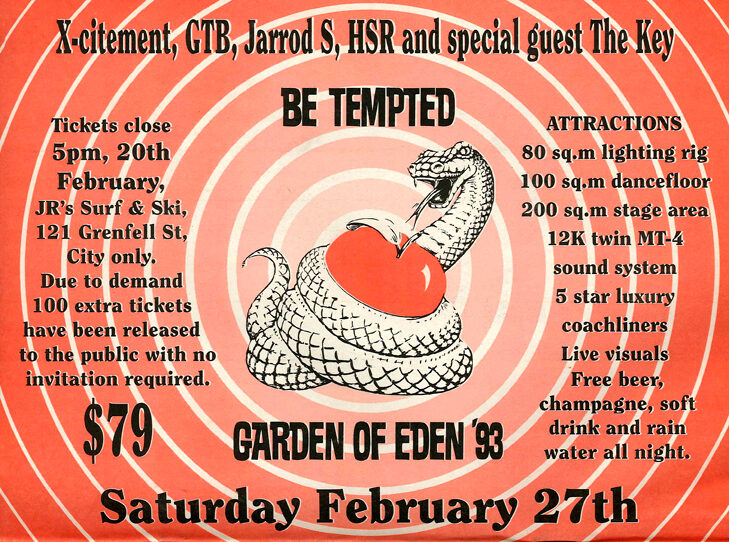
In early 1993, an ambitious event concept emerged in Adelaide’s dance music scene, promising a significant departure from the standard club night. Billed as Garden of Eden ’93, it was a meticulously planned, all-inclusive party scheduled for late February, designed to transport 400 attendees by luxury coach to a secret beach location. The event offered a complete sensory and logistical package, aiming to create a temporary, high-production nightclub experience under the stars.
I. Event Concept and Organization
The strategic vision behind Garden of Eden ’93 was to transcend the conventional boundaries of a rave by occupying a unique space between underground exclusivity and professional transparency. Organizer Matt Sampson neatly captured this hybrid approach, stating, “It’s an underground party but at the same time nothing has been hidden.” Since September of the previous year, his team had been planning not just a party, but a temporary, 400-person “club” built from the ground up for a single night on a remote private beach, signaling a move towards curated, high-service experiences within the dance music culture of the era.
The foundational details of the event were clearly defined:
- Event Date: The party was scheduled for Saturday, February 27th.
- Core Vision: The central goal was to establish a fully equipped, 400-person dance party on a remote beach, a concept that had been in development for over five months.
- Official Approvals: Organizers demonstrated due diligence by consulting with relevant authorities, including the Country Fire Service (CFS) and the Department of Marine and Harbours, to ensure compliance and safety.
The ticketing structure reflected the event’s premium, all-inclusive model. Tickets were priced at $79 and were sold exclusively at JR’s Surf & Ski, located at 121 Grenfell Street in the city. A strict sales deadline was set for 5pm on Saturday, 20th February, to finalize logistics. Initially planned as an invitation-only affair, significant public interest prompted the organizers to release an additional 100 tickets to the general public, removing the invitation requirement to meet the demand.
This comprehensive planning set the stage for an event defined not just by its music, but by its unique and mysterious location.
II. The Secret Location and Venue Preparation
The mystique of Garden of Eden ’93 was deeply intertwined with its undisclosed venue, a key element of its marketing and appeal. The promise of an exclusive gathering at a secret location created a powerful sense of anticipation. Attendees were told only that the party would take place “somewhere on Yorke Peninsula,” at an “excellent 25km long private beach” so remote that, as one source suggested, “You can head down there and have a bit of a chill for a week.”
Transforming this raw coastal landscape into a fully functional party venue required extensive preparation and heavy-duty engineering. The organizers undertook a significant construction effort to ensure the comfort and safety of guests and provide a professional-grade experience.
- Ground Work: To create a stable surface for dancing and amenities, the entire beach area was “firmly floored.” An 8-wheeled articulated tractor was brought in to level the sand, allowing for the installation of a proper dancefloor.
- Structures: A series of large marquees were erected to house the event’s key facilities, including the bar, a VIP lounge, a lush lounge, and a cafe area.
- Venue Dimensions: The scale of the build-out was substantial, with specific areas measured to accommodate the crowd and production elements:
- 3000m² complete dance party area
- 100m² dancefloor
- 200m² stage area
This physical construction provided the foundation for the sophisticated technical production that would bring the remote location to life.
III. The Sensory Experience: Music and Visuals
To complement the unique location, the organizers assembled a high-level technical production and a diverse musical lineup designed to create a premium, immersive audio-visual experience. The ambition was to deliver a sensory spectacle that rivaled, and perhaps surpassed, the offerings of established city venues.
The music programming included a robust lineup of local DJ talent alongside a planned live electronic music performance.
- DJs: The announced roster featured some of the scene’s key figures, including X-citement, GTB, Jarrod S, HSR, and special guest The Key.
- Live Performance: A significant feature was the plan for a live act, which could perform for up to an hour. The setup involved bringing in a substantial amount of equipment, including keyboards, DAT machines, and 909s. The live ensemble was conceived to include up to seven people: two DJs, a keyboard operator, a percussion controller, another keyboard controller, an MC, and back-up vocals.
The technical specifications for the event’s sound and lighting were equally impressive, promising a powerful and visually dynamic environment.
- Sound System: A 12K twin MT-4 sound system was specified for the event, described by organizers as “plenty loud.”
- Lighting Rig: An expansive 80 sq.m lighting rig was to be installed, utilizing eight Miniscans and other equipment previously featured at the high-profile Independance event.
- Visuals: In addition to the lighting, “live visuals” were promoted as a key attraction, promising a rich visual component to the night.
This focus on a high-fidelity sensory experience was matched by an equal commitment to the logistical and practical needs of the attendees.
IV. Logistics and Attendee Experience
A core component of the Garden of Eden ’93 concept was its all-inclusive, high-service approach to logistics, which set it apart from more spartan, do-it-yourself outdoor parties. The ticket price covered nearly every aspect of the attendee’s journey, ensuring a seamless and comfortable experience from departure to return.
Transportation was a key feature of the all-inclusive package. Attendees were transported to the secret location via five-star luxury coachliners. The coaches were scheduled to depart the city at 6:30pm for the three-hour journey, which included a planned roadhouse stop for a meal. To accommodate different preferences, return trips were staggered, with departures from the beach scheduled for 6am, 8am, and 10am.
Once on-site, a wide range of food and beverages were provided as part of the ticket price.
- Complimentary Items: The following were provided “on the house” all night:
- Beer
- Champagne
- Soft drink
- Rainwater
- Fruit juices and fruit shakes (made from pineapple, banana, strawberries, orange juice, and frozen yoghurt)
- Free lollies and gum available at the bar
- Items for Sale: For those seeking additional snacks, crisps, refrigerated fruit, and cheese were available for purchase.
Safety and security were also carefully considered. Organizers implemented a “partner system” to ensure that no one was accidentally left behind at the remote location. On-site security was managed by a team using three mobile vehicles operating on VHF radios. Reflecting the controlled and exclusive nature of the event, organizer Matt Sampson issued a clear warning to any potential gate-crashers: “don’t bother.” This comprehensive logistical framework was the final element that solidified the event’s identity as a premium, fully curated experience rather than a conventional rave.
Leave a Reply