
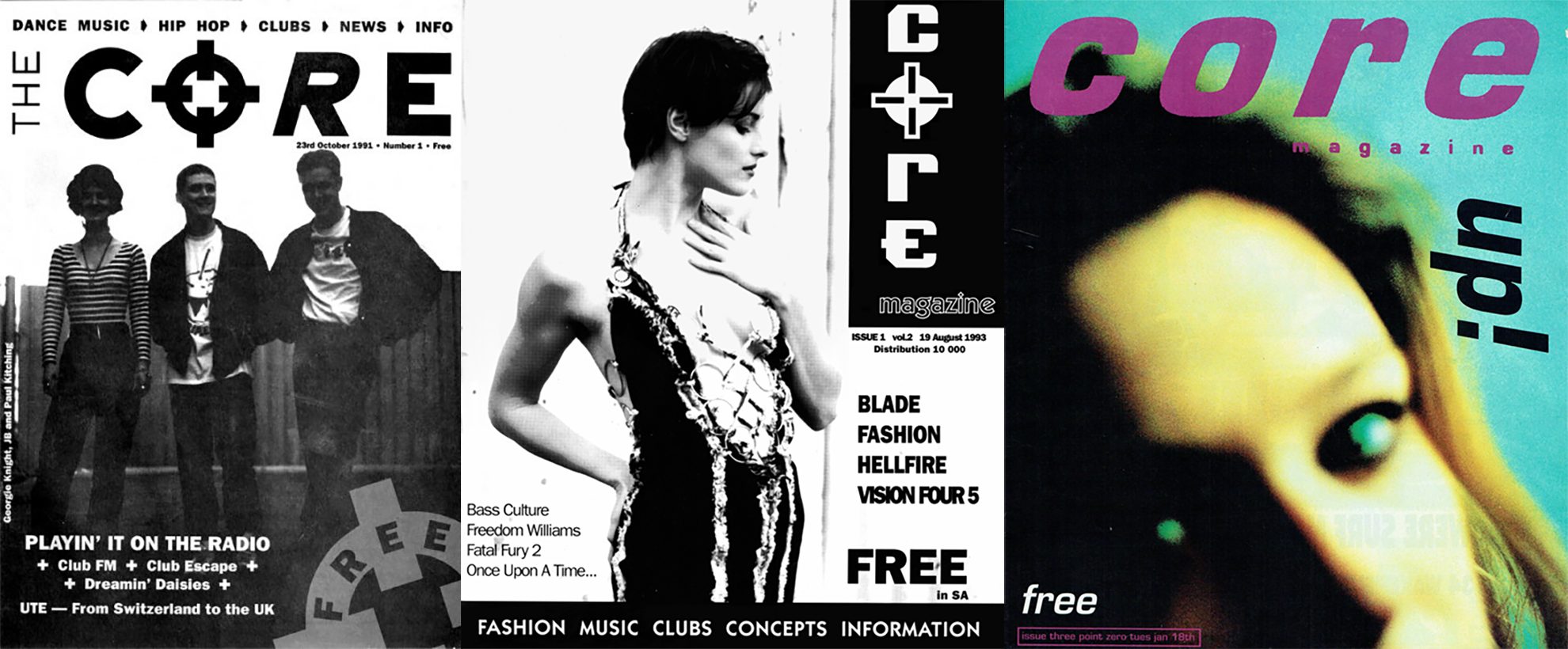
Through two names, two ownership groups and a sometimes uncertain change of guard, Adelaide’s principal dance-music magazine recorded a scene while it was still finding its feet.
For much of Adelaide’s dance-music community, there was simply The Core.
The finer distinctions, between The CORE and Core Magazine, between Core Productions and Neo Productions, and between one group of proprietors and the next, were rarely as clear to readers as they appeared on company records and mastheads.
The changeover was blurred. Contributors moved between the two publications. Design work continued across the divide. Writers became editors, business partners became publishers, and much of the magazine’s subject matter passed from one operation to the next.
To the public, it looked like one magazine going through a restless period. In business terms, it was two related publications produced by two different partnerships.
Together, they documented four important years in Adelaide music.
The Core Productions Years
The CORE began in October 1991 under Core Productions, owned by Acb Tyson and Stilgherrian.
Its arrival was direct and energetic. From issue C1 through to C91, the publication appeared weekly. There was little hesitation and no lengthy settling-in period. It reported on clubs, records, performers, promoters and the people building Adelaide’s developing dance-music culture.
Tyson served as the magazine’s graphic designer and editor, giving The CORE much of its visual character. He was also a co-owner and remained closely involved in the practical work of putting each issue together.
Stilgherrian was the publication’s principal writer and wordsmith. His contribution helped establish the magazine’s voice: informed, observant and closely connected to the people and events it covered.
The magazine was not written from a comfortable distance. Its contributors were participants in the same community they were reporting on. They knew the clubs, the promoters and the arguments. They understood which records were being played, which nights were drawing crowds and which ideas were beginning to take hold.
That closeness gave The CORE immediacy, although it also meant that the boundaries between publication, promotion and participation were not always sharply drawn.
Matt Pearce contributed written material during this period. Paul Hamon was also involved, dealing largely with the business side while supplying copy when required. Hamon later described his own writing contribution with considerably less enthusiasm than he reserved for the work of the magazine’s stronger writers.
Their involvement would prove important. When Core Productions ceased publishing in July 1993, Pearce and Hamon were not outsiders attempting to imitate what had gone before. They had already worked within it.
A Change of Hands
In August 1993, Neo Productions took over the next stage of the publication’s life.
The new partnership consisted of Paul Hamon, Matt Pearce and Tae Won Lee, also known as Tae Lee.
The title became Core Magazine. The word “The” was no longer formally central to the name, although many readers continued to use it. The style, production schedule and internal responsibilities also changed.
Pearce moved from contributor to editor. Hamon continued to handle much of the commercial and administrative work. Tae Lee became the magazine’s graphic designer and a partner in the business.
Acb Tyson, despite no longer being one of the proprietors, designed a small number of issues during the Neo Productions period. His continued involvement added to the sense that the two magazines were connected rather than entirely separate enterprises.
The centre of gravity had shifted, but much of the magazine’s working knowledge, contacts and subject matter remained.
This was not a conventional sale followed by a clean relaunch. It was a gradual transfer involving people who had already been active in the earlier publication. Roles changed more clearly than the magazine’s identity did.
For readers collecting copies from week to week—or whenever the next issue appeared—the legal and editorial distinctions were easy to overlook.
A Less Predictable Magazine
Where The CORE had maintained a demanding weekly schedule, Core Magazine was less consistent.
Between August 1993 and approximately July 1995, Neo Productions published about 37 issues. The precise number and dates require confirmation against surviving copies, but the contrast in frequency is clear.
The first publication had produced roughly 91 weekly editions in less than two years. Its successor produced fewer than half that number across a similar period.
That irregularity did not necessarily lessen the magazine’s place in Adelaide music. It did, though, reflect the difficulties faced by small independent publications: uncertain income, limited staff, changing partnerships, production demands and the constant pressure of finding enough time and money to prepare another issue.
Such magazines were rarely produced under orderly circumstances. Pages were written, designed and assembled by people who were also working, promoting events, attending clubs and participating in the culture they covered.
Publication dates slipped. Responsibilities overlapped. Business arrangements changed. Yet the magazine continued.
One Magazine in the Public Memory
In formal terms, The CORE and Core Magazine belonged to separate publishing periods.
Core Productions, owned by Acb Tyson and Stilgherrian, published the weekly The CORE from October 1991 until July 1993.
Neo Productions, owned by Paul Hamon, Matt Pearce and Tae Won Lee, published Core Magazine from August 1993 until about July 1995.
In public memory, however, the distinction is less exact.
The same scene filled both publications. Several of the same people worked across both periods. Pearce and Hamon had contributed to The CORE before becoming owners of the successor publication. Tyson’s design work appeared in both. Artists, clubs, promoters and readers moved through the pages without observing the corporate boundary.
For many people, it remained “The Core”—a familiar title that arrived in different forms, under different management and with varying regularity.
That popular understanding is not entirely wrong. While the ownership changed, much of the magazine’s purpose continued.
It remained a record of Adelaide dance music during a period when the scene was growing rapidly but had not yet settled into an established industry. Clubs appeared and disappeared. Musical styles changed quickly. Local performers competed for attention alongside international releases. Promoters experimented with venues, formats and audiences.
The magazine followed that movement from close quarters.
A Record of a Developing Scene
The importance of the surviving issues lies not only in their stories or photographs, but in their cumulative record.
Taken together, the magazines show how Adelaide’s dance-music community spoke about itself between 1991 and 1995. They record names, events, advertisements, opinions and associations that might otherwise have disappeared.
In retrospect, the four-year run appears brief. At the time, it covered a large part of a young scene’s development.
The publication began with Tyson and Stilgherrian producing a determined weekly title. It continued under Hamon, Pearce and Lee as a less regular but recognisably related magazine. Between them, the two partnerships produced approximately 128 issues.
There was no perfectly neat handover and no single moment when the old magazine ended and an entirely new one began.
There was instead a change of ownership, a change of roles and a continuation of purpose.
That uncertainty became part of the publication’s history. It also explains why, three decades later, so many readers remember two magazines as one.
Publication Timeline
October 1991
Core Productions begins publishing The CORE.
October 1991–July 1993
Acb Tyson and Stilgherrian own Core Productions. A clockwork 91 weekly issues are published.
July–August 1993
The publication passes through an informal and sometimes unclear transition between the two ownership groups.
August 1993
Neo Productions begins publishing Core Magazine.
August 1993–approximately July 1995
Paul Hamon, Matt Pearce and Tae Won Lee own Neo Productions. Approximately 37 issues are published on a less regular schedule.
Principal People
Acb Tyson
Co-owner of Core Productions; graphic designer and editor of The CORE. Also designed several issues of Core Magazine.
Stilgherrian
Co-owner of Core Productions; principal writer and wordsmith for The CORE.
Paul Hamon
Business and administrative contributor during The CORE period; later co-owner of Neo Productions. Also contributed occasional written material.
Matt Pearce
Writer for The CORE; later editor and co-owner of Core Magazine.
Tae Won Lee — Tae Lee
Graphic designer and co-owner of Neo Productions during the Core Magazine period.
Archive and Rights Notice
Magazine content reproduced on this website is:
© Core Productions 1991–1993 and an Anthems special addition in 1998.
© Neo Productions 1993-1995.