
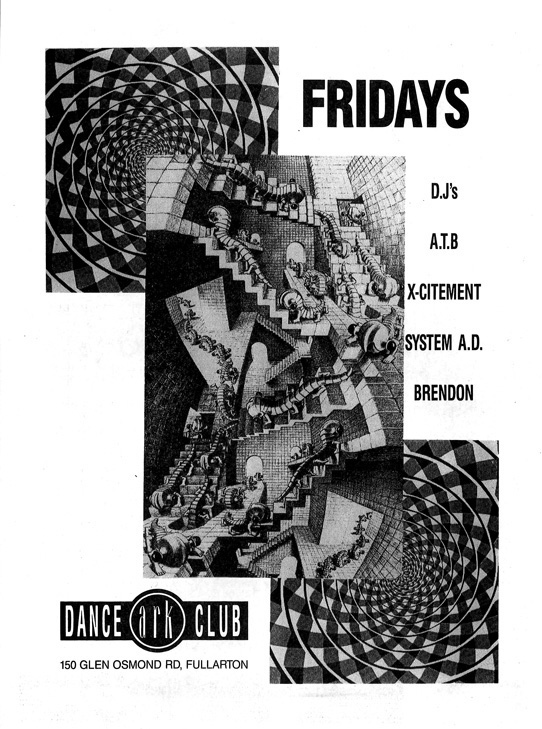
In the burgeoning electronic music landscape of early 1990s Adelaide, Fridays at The Ark Dance Club emerged as an essential weekly institution. The venue became a crucial nexus for the city’s dance culture, consistently showcasing a forward-thinking blend of pioneering international artists and foundational local talent.
The Heart of the Scene
The Ark Dance Club stood as a central and influential pillar of Adelaide’s nightlife, providing a consistent and highly anticipated destination for the city’s dance music enthusiasts. The success of a regular, well-attended club night is vital for nurturing a local scene, offering a platform for artists to develop and a space for the community to gather, and The Ark’s Friday night programming fulfilled this role perfectly.
Described as an “increasingly popular” club, The Ark consistently drew significant numbers, with events frequently commanding “packed” crowds. Period reviews confirm a vibrant, high-energy environment where resident acts like X-citement were tasked with getting the “dancefloor going” and international headliners like DJ Westbam “had the crowd rocking throughout the night.” This sustained popularity solidified The Ark’s reputation as not just another club, but as the very heart of the scene—a reputation built upon the specific musical identity that came to define its Friday nights.
The Evolving Sound of ’93
The music curated at a leading venue like The Ark served as both a mirror and a catalyst for the electronic music trends of the era. The club’s Friday night selections were a direct reflection of the global sounds filtering into Australia while also actively shaping the tastes of the local Adelaide audience. This created a dynamic feedback loop where the club and its patrons evolved together.
The musical identity of “Fridays @ The Ark” was diverse yet cohesive, centered on the harder, more energetic edge of dance music that was gaining prominence in 1993. The sounds featured were a blend of established and emerging genres, showcasing the venue’s commitment to a forward-thinking sonic palette:
- Hard, melodic, and trancy: A description of the wider Adelaide sound, which was heavily featured at The Ark.
- Hardcore and European sound of ’93: The club embraced the raw energy of hardcore while also presenting the more refined, but equally intense, techno and trance sounds developing across Europe.
- Acid, speed garage, and techno: These styles formed the core of many DJ sets, highlighting a focus on hypnotic rhythms, deep basslines, and relentless energy.
This distinct sound was championed by the world-class international DJs who were regularly brought in to headline the club’s flagship Friday night.
A Showcase of International Talent
In a pre-internet era, a key element of The Ark’s success was its role as Adelaide’s premier platform for international DJ talent. For a geographically isolated scene, hosting these influential artists was more than just a booking; it was a rare and vital connection to the global dance music movements unfolding in hubs like Belgium, Berlin, and New York. These nights offered local artists and audiences an unfiltered, firsthand experience of the cutting edge, providing inspiration that couldn’t be streamed or downloaded.
Frank De Wulf: The “Inspirational” Belgian Sound (March 1993)
On Friday, March 5th, The Ark hosted special guest DJ Frank De Wulf, a key figure from the Belgian techno scene. His set was described as “absolutely mind blowing” and a masterclass in building energy, characterized as “hard but not hardcore.” The performance was so impactful that local luminary DJ HMC called it “the most inspirational night I’ve heard in a long time.” The set also sparked debate among the crowd, with some finding it “not hardcore enough.” However, the reviewer’s final assessment was that De Wulf’s performance perfectly represented the progressive “European sound of ’93.”
DJ Westbam: A Berlin Techno Marathon (June 1993)
Berlin’s DJ Westbam took to the decks on Friday, June 11th, delivering a marathon five-and-a-half-hour set. He traversed a range of styles, including acid, speed garage, and techno. While one review noted that the performance may have been “a little too polished,” it was undeniably effective, as Westbam successfully “had the crowd rocking throughout the night.”
Other Headlining Acts
Throughout the first half of 1993, The Ark’s Friday nights featured a strong lineup of significant artists, further cementing its reputation.
- Too Strong: The Adelaide-based act performed live on Friday, February 26th.
- Lenny Dee: The iconic American hardcore and industrial techno DJ was scheduled as a special guest on Friday, April 9th.
While these international headliners drew the crowds, it was the club’s resident and local DJs who provided the essential foundation for the night, week after week.
The Core of the Local Scene
The crucial role of resident and local DJs in building a club’s identity cannot be overstated. At The Ark, these artists were responsible for setting the tone, warming up the dancefloor, and creating a sense of continuity that grounded the experience for regulars. They were the backbone of the club, providing the perfect musical context for the international guests to shine.
Several key local figures were consistently associated with Fridays at The Ark, each contributing to its unique atmosphere.
- DJ Brendon: A prominent figure, Brendon was tasked with warming up for international acts like DJ Westbam. After Frank De Wulf’s set, he notably played “We Are The Future”—a hard-hitting track he had co-produced.
- Travis Olifent: Identified as a “regular DJ at Heaven and the Ark,” his presence at multiple key venues was characteristic of the era’s tight-knit scene, where a core group of DJs defined the city’s sound.
- X-citement: This act played a vital role in the early hours, credited with getting the “dancefloor going” before Frank De Wulf’s headline performance.
- Kirsty Whicker: Her official affiliation with the venue was highlighted when she was listed as a judge representing “The Ark” for the prestigious 1993 DMC Championship.
The deep bench of local talent demonstrates that The Ark was more than just a stage for touring acts; it was an incubator for Adelaide’s own DJ culture.
A Hub for Adelaide’s Music Culture
Beyond its celebrated Friday nights, The Ark functioned as a central hub for significant events that shaped Adelaide’s broader music culture. Its status as a premier venue made it the natural choice for hosting events that required a credible and popular location, capable of drawing large and enthusiastic crowds.
The club’s importance was cemented when it was chosen as the host venue for the 1993 DMC Championship, holding both the heats and the finals, with the first heat taking place on Thursday, 15th April. This major DJ competition, a cornerstone of turntablist and hip-hop culture, drew a “massive crowd” to the location. By hosting such a high-profile event, The Ark proved it was more than just a dance club; it was an indispensable institution. It served as a crucible where a uniquely Adelaide version of the ’90s dance movement was forged, shaped by the vital exposure to global trends and nurtured by the strength of its own local talent.
Leave a Reply
You must be logged in to post a comment.