
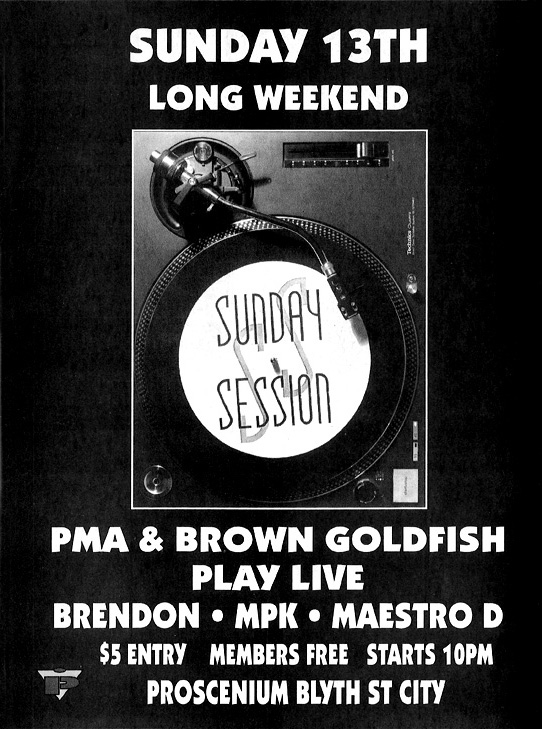
In the thick of 1993, promoters were constantly looking for an edge, a way to carve out a unique space in a crowded nightlife calendar. The “Sunday Session” at Proscenium was a calculated response to the prevailing club culture, a carefully programmed night designed to capture the long weekend crowd on June 13th with a more relaxed vibe, blending the raw energy of live bands with the continuous beat-matching of the city’s finest DJs.
Event Details
The “Sunday Session” was positioned as a distinct alternative for those seeking a different kind of night out. Held at the Blyth St venue Proscenium, the event was set to kick off late, offering a sonic sanctuary that would run into the early hours of the holiday morning.
- Date: Sunday, June 13th (Long Weekend)
- Venue: Proscenium, Blyth St City
- Start Time: 10 PM
The event’s appeal was built around a hand-picked roster of performers, chosen specifically to create its signature atmosphere.
The Lineup
The decision to pair live acts with a trio of established DJs was a classic 90s promoter’s gambit: it broadened the event’s appeal, anchoring the night with the visceral energy of a live band while ensuring a continuous atmosphere on the dancefloor through the DJs.
Live Acts
The live component of the evening featured two bands from the local scene:
- PMA
- Brown Goldfish
DJ Sets
Handling the decks were three notable DJs from the local circuit, whose presence on a lineup was a trusted seal of quality for clued-in regulars:
- Brendon
- MPK
- Maestro D
Musical Style
In a scene often dominated by high-energy rave and hard-edged techno, the “Sunday Session” carved out its niche by promising a more atmospheric sound. This was a deliberate counterpoint to the more frantic styles prevalent at other venues, positioning the night as a more sophisticated, “chill-out” alternative. The promoters’ own description, printed in The Core, left no ambiguity about the intended sonic direction:
The music will be mellow, lots of the slower, smoother, trancier variety.
This focus on a smoother soundscape was key to the night’s identity, directly influencing the type of crowd it sought to attract.
Admission Information
The entry fee for the event was structured to reward venue regulars while remaining accessible to newcomers. This two-tiered pricing model was a common practice designed to foster a loyal community around a specific club or event series.
- Standard Entry: $5
- Members: Free Entry
While the entry details were straightforward, the promoters found it necessary to issue a public clarification regarding a recent advertisement to ensure there was no confusion.
Advertisement Clarification
In an age before instant digital updates, communication between promoters and their audience was a direct, if sometimes unpolished, affair played out in the pages of street press. A notice printed in The Core from Instamfamous Productions perfectly captured this dynamic, as they moved to correct a mistake in a previous week’s advertisement.
The mix-up involved the band S.T.A.T.E. A prior advert had mistakenly implied they would be performing, forcing the promoters to issue a clear correction: S.T.A.T.E. would not, in fact, be playing on Sunday, June 13th. With a candidness typical of the era, Instamfamous Productions offered the assurance that “This hasn’t caused any inconvenience to anyone.”
The Future of Sunday Sessions
This inaugural long weekend event was never intended as a one-off. It served as the launchpad for a more ambitious project, signaling confidence in a concept that could become a new staple of the city’s nightlife.
Following the June 13th session, the event was scheduled to become a weekly fixture. In a significant move to build a consistent following, it was also announced that all future weekly events would have free entry for all. This kind of rapid pivot illustrates the fast-paced, experimental, and community-focused nature that defined the 90s independent club scene.
Leave a Reply
You must be logged in to post a comment.