
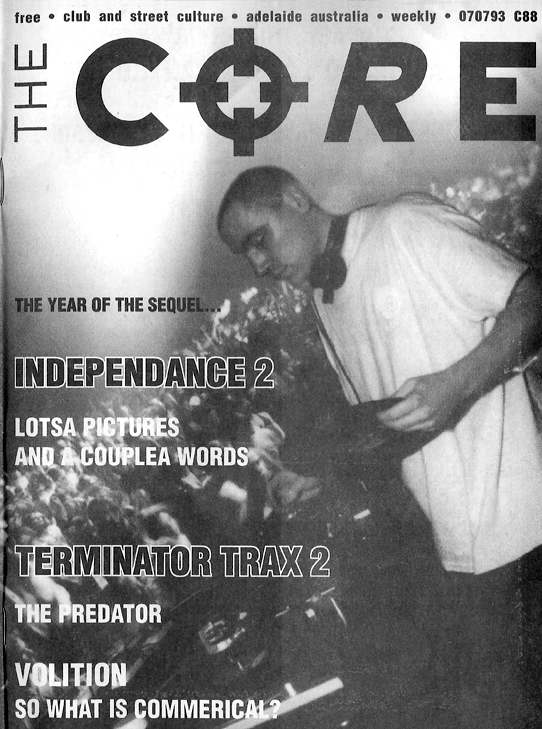
In mid-1993, Adelaide’s youth culture was a dynamic ecosystem of sound, style, and innovation, all captured within the pages of its sole club culture magazine, “The Core.” The publication’s July edition, explicitly branded “THE FUTURE ISSUE,” serves as a definitive record of a city’s creative scenes defining their vision of what was to come. Centered around the release of a landmark local electronic music compilation, this archival snapshot chronicles the music that defined the dancefloors, the nightlife that housed the community, the fashion and design that clothed it, and the global media that influenced it all.
The Core EP: A Showcase of Adelaide’s Electronic Future
At the heart of the city’s burgeoning electronic music scene was The Core EP, a strategic compilation designed to showcase local talent to a wider audience. The project was a significant focal point for the community, representing a collaboration between Adelaide’s “The Core” magazine and the Melbourne-based record label Vicious Vinyl. It served as a tangible declaration of the city’s creative potential and its ambition to contribute to the future of dance music.
The Project’s Genesis
The journey of The Core EP began with a simple call to action. “The Core” magazine, in its partnership with Vicious Vinyl, placed an advertisement with the headline, “We Want To Hear Your Music,” inviting local producers to submit their work. The response was immediate and overwhelming; 29 different artists submitted more than 70 tracks, with a limit of four per artist. From this impressive pool of local productions, a panel selected four distinct tracks that would come to represent the contemporary Adelaide sound on the compilation.
Featured Artists and Their Tracks
The four artists chosen for the EP each brought a unique perspective and production style, reflecting the diversity within the local electronic scene.
- DJ Brendon and DAMC: The duo contributed the track “We Are The Future,” which also became the title of the EP’s launch party. Brendon, a relative newcomer who had only begun DJing in mid-1992, collaborated with DAMC to create a sound they described as a “cross between American and English music.” Their track was built from various samples and reflects their hands-on, experimental approach to production.
- Forge (Maas Unconscious): Comprised of Gordon and Nik Holt, this duo produced the track “Forge.” Having played their first two live shows at Boltz Cafe and Under The Crooked Banyan, their approach was decidedly DIY, with equipment described as “completely borrowed from a William Gibson book.” Their commentary on the creative process was pointedly ironic, reflecting on the difficulty of titling their work: “a name is easy to come up with, but names are fucked.”
- Apollo (Aquila): Behind the name Apollo was Matt Thomas, an Arts student whose track was deeply influenced by the international techno landscape. His studio setup included iconic equipment like the Roland TR 808 drum machine and the TB 303 bass synthesizer, and he cited influential labels such as +8, Djax, and Evolver as key inspirations. Thomas saw the EP as a “great leap forward,” but also articulated a philosophy for the scene, believing local artists needed to “personally work hard on each track letting them evolve and grow” to successfully “push the Adelaide scene… into the world arena.”
- Time² (Quantization): The youngest artist on the EP was 15-year-old Matt Berrington, who produced the track “Time².” Working with a Roland 707, an Ensoniq 16 Track sequencer, and a classic 88-key keyboard, Berrington demonstrated a sophisticated production philosophy. He consciously chose not to sample the ubiquitous Roland TB-303, reasoning that it was the “bread and butter of English acid artists” and he wanted to pursue a different sound, focusing instead on the creative potential of sampling vocals.
The “We Are The Future” Launch Party
To celebrate the EP’s release, a massive dance party was organized. The event, aptly named “We Are The Future,” was held on Saturday, July 24th, 1993, at the expansive function room of the Cheltenham Racecourse, a venue capable of holding up to 2000 people. Promotional materials captured the urgency of the moment, advising attendees: “Remember, this might be the last time The Core EP will be made available this cheap.”
The party featured an extensive lineup of the city’s top talent: DJs Brendon, HMC, Angus, MPK, PMA, DAMC, Aquila, Maas Unconscious, and MCs Maestro D & Tim.
Tickets were made available through Austickets and Central Station Records. As a special promotion, ticket holders received a 10% discount on all merchandise at Central Station Records, further integrating the event with the city’s key cultural retailers. This event was a cornerstone of the broader, energetic nightlife that defined the city at the time.
The Pulse of Adelaide’s Nightlife
Beyond the singular focus of the EP launch, Adelaide in July 1993 offered a diverse and dynamic range of club nights and parties. The city’s venues were alive with distinct sounds and crowds, from intimate weeknight gatherings to large-scale weekend events. This landscape was shaped by a core group of venues, promoters, and the resident DJs who defined the city’s sonic identity.
Key Events and Venues
A survey of event flyers and the “Clubland” review column reveals a bustling and varied nightlife scene. Notable weekly and one-off events included:
- Total Recall: A major event at Dance Club UTI (150 Glen Osmond Rd, Fullarton), featuring headline DJs Brendon, ATB, & Uzi, and hosted by MCs Tim & Maestro D.
- Pulse at the Ark: A popular Wednesday night that combined clubbing with culture, featuring DJs Nitin and E-Zee+G alongside a fashion show.
- New Jack City: Located at 171 Hindley St, this venue was promoted as “Adelaide’s sole new jack club,” holding events every Friday and Saturday.
- Discovery: A Thursday night fixture at 69 Light Square, City, with resident DJs ATB & MPK and MCs Maestro D & Tim.
- Escalate: Held on Fridays at McMahon’s in Salisbury (10 Park Terrace), this club distinguished itself with an “intelligent laser system” and music from DJs Jason > Gary.
- Synagogue: A key venue hosting events on both Thursdays and Saturdays, with the Saturday night being a major promotion by Metro.
- Underground Solution: A Thursday night event noted in reviews for being surprisingly busy and possessing a genuinely good vibe.
A Spotter’s Guide to Local DJs
The club scene was anchored by a roster of well-known local DJs, many of whom held multiple residencies across the city’s top venues. The “Spotter’s Guide to Adelaide DJs” provides a who’s who of the talent driving the scene:
- Angus: Unity
- ATB: Ark, Discovery
- Brendon: Heaven, Synagogue, Ark, Unity
- Diamond: New Jack City
- E-Zee+G: Pulse, F.U.S.E.
- GTB: 151, Tapas
- HMC: Synagogue
- MPK: Discovery
- Nigel: Astor, State
- PMA: Discovery
- Therio: New Jack City
- Uzi: Synagogue, State
Perspectives from the Scene
The “Correspondence” section of “The Core” magazine reveals a passionate, articulate, and often contentious community. Letters to the editor served as a public forum for raw debate, far from a unified chorus of praise. While some lauded The Core EP for putting Adelaide on the map, others engaged in fierce arguments over the city’s musical direction, pitting the “hip/hop/funk movement” against the perceived dominance of “techno/rave.” Criticism was pointed and specific, with one reader dismissing a piece as a “shitty pissant article” and another calling out the “phucked attitudes” of certain club owners and bouncers. This forum for public opinion underscores a scene that was not only consuming the culture but actively and fiercely shaping it.
Future-Forward: Adelaide’s Creative Culture
The “Future Issue” theme was not limited to music; it permeated other creative fields, highlighting a new wave of local designers in fashion, jewellery, and digital art who were shaping Adelaide’s contemporary aesthetic. These innovators blended underground sensibilities with skilled craftsmanship, creating a distinct visual identity for the city’s youth culture.
Streetwear and Local Fashion
Adelaide’s fashion scene was characterized by a mix of unique, designer-led creations and accessible streetwear. Designers like Scarab Design by Katrina and Xenobia were recognized for “influencing the future with a twist of what’s to come,” creating garments with originality and a spirited edge. Simultaneously, the streetwear brand Funkessentials, founded by Bruce Slorach and Sara Thorn, was making a significant leap from a niche market into major department stores, signaling the growing commercial viability of local, youth-oriented fashion. The retail landscape was equally diverse, with stores like The Little House of Treasure offering recycled fashion and Tuff For Men providing a range of contemporary menswear.
Innovative Jewellery and Digital Art
A particularly innovative corner of the design scene was jewellery, where local artisans adopted a “warriors way” theme, crafting bold, one-off pieces that blended intricate detail with powerful symbolism.
- George Pliônis: His intricate work included a handcrafted katana sword (using ebony wood, bronze, brass, and steel) and an elaborate chest plate necklace.
- Rachael Grigulis (Metalismith): Contributed to the aesthetic with custom bat and disc pendants.
- Guy — Brandwood Design: Created a shield and a set of “pen-dants” in the form of a miniature sword and sheath.
- Gerard Mignone: Crafted a striking ninja’s lacquered sword.
Alongside this tangible craft, new forms of digital art were emerging. The “holusion” was described as a computer-generated print with compelling 3-D qualities that shifted as the viewer moved. At the Art Images gallery, artist Philip George showcased computer art that served as a direct technological and philosophical counterpart to the electronic music scene. His work, which incorporated complex fractal imagery, was described as being “all about sampling, like a dance music DJ.” This parallel framed his digital practice not as an adjacent art form, but as a visual manifestation of the same remix culture thriving in the city’s clubs.
Broader Cultural Currents
Adelaide’s local culture existed within a global context, with international music, film, and new technologies shaping the interests and conversations of the time. The city’s DJs, artists, and consumers were keenly aware of trends emerging from the US, UK, and beyond, integrating them into the local fabric.
Global Music and New Releases
International music news featured prominently, with profiles on global artists like the influential DJ and remixer David Morales and the rising R&B star Mary J. Blige. The distribution of this music was critical, and Shock Distribution was a key player, having been voted the No. 1 distributor by the Australian Music Industry Directory for 1993. Shock heavily advertised new compilation albums that were shaping dancefloors, including Adrenalin Vol 1 & 2, General Base, and Best of Acid Jazz Vol 2. Album reviews covered a wide spectrum, from a New Order tribute album to new releases from hip-hop group The Goats and electronic act The Shamen, reflecting the diverse tastes of the audience.
Film, Gaming, and Media
The world of cinema was also a major topic of interest, with a particular focus on the kinetic action films of Hong Kong director John Woo. Reviews also covered mainstream and cult releases like Vampire’s Kiss and the Sylvester Stallone blockbuster Cliffhanger. In the realm of technology, excitement was building for the next generation of video games. The “Future Games” column detailed the forthcoming Panasonic REAL 3DO Interactive Multiplayer, a 32-bit CD-ROM-based console positioned to compete with Sega’s Mega-CD. A key title announced for this powerful new platform was Total Eclipse by Crystal Dynamics, promising a leap forward in home gaming experiences.
Leave a Reply
You must be logged in to post a comment.