
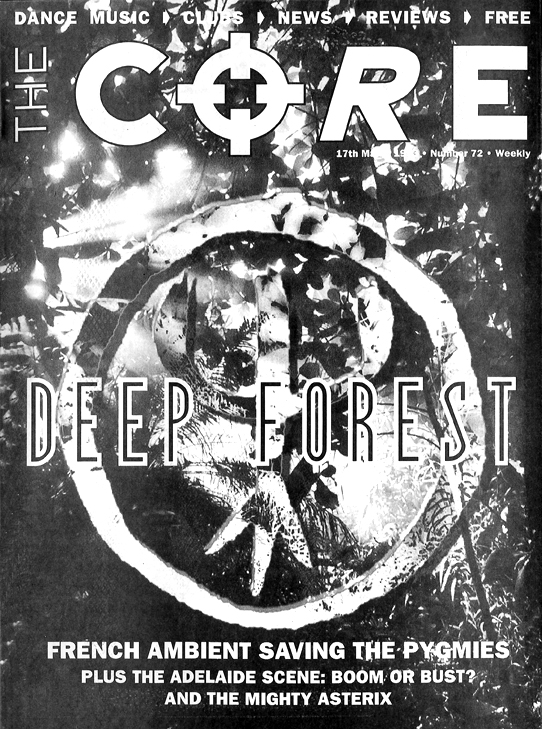
In March 1993, the world of dance music was a culture in motion, a vibrant ecosystem of sound and ideas stretching from the ambient studios of France to the pulsing dance floors of Adelaide. This dispatch from the frontline captures a pivotal moment, exploring the pioneering world-fusion of Deep Forest, the intense identity struggles roiling Adelaide’s local club scene, and the raw reggae stylings of New Zealand’s The Mighty Asterix. It is a snapshot of a scene defined by the tension between global trends and hyper-local debates, chronicled through new releases, industry news, and on-the-ground reports.
Deep Forest: Fusing World Music with French Ambient
At a time when electronic music was rapidly expanding its sonic palette, the French duo Deep Forest embarked on a unique and ambitious project that challenged the boundaries between technology and tradition. Their work represented a pioneering effort to blend the ethereal textures of ambient electronic music with the profound, ancient sounds of indigenous cultures. At the heart of their mission lay the dual themes of artistic innovation and the urgent need for cultural preservation, specifically focusing on the Pygmy communities of Central Africa.
The Mission and Its Origins
The creative force behind Deep Forest consists of two French musicians, Michel Sanchez and Eric Mouquet. Their stated goal was to “introduce African culture to millions of people around the world” and, in doing so, help save the rich cultural heritage of native peoples before it disappears. This mission earned their debut album an endorsement from UNESCO (United Nations Educational, Scientific and Cultural Organization). To realize their vision, they collaborated with Belgian pro-producers Guillain Joncheray and Dan Lacksman, employing sophisticated studio techniques to create an immersive sonic experience.
“We use the Roland for mixing at the end of the album,” says Eric, “It’s a serious-sound effect, like in a cinema. You can feel sound around you.”
Crafting a Global Sound
A direct descendant of Jean Michel Jarre’s acclaimed Zoolook album, the duo’s debut, Deep Forest, was meticulously crafted in a studio over the course of a year, with Eric Mouquet spending several weeks in Africa. The album’s distinctive sound is built upon vocal samples and water drum sounds sourced from traditional Pygmy chants, specifically from the Debeele tribe of southern Africa. These organic elements were then intricately woven into a lush tapestry of modern electronic music. The project was a truly international collaboration, involving musicians from France, India, Spain, and England.
The result was a commercial success, with the album quickly entering Australia’s Top 20 charts; notably, Australia was the first English-speaking country to break Deep Forest. The lead single, “Sweet Lullaby,” became an international hit, introducing their unique sound to a global audience. Both the debut LP and the single are available on Sony Music.
A Discussion of Culture and Collaboration
Despite its success, Deep Forest’s methodology sparked critical debate. Some critics argued that their approach risked diluting the original culture, raising concerns that Westerners might be “stealing the culture of those less able to protect themselves.”
The group countered this perspective by framing their work as an act of preservation and awareness. They argued that by bringing these sounds to a mainstream audience, they were generating crucial interest in endangered cultures. Mouquet defended their intentions, stating that a portion of the album’s royalties would be directed to the Pygmies to help protect them from modern diseases.
“We tried to have to love them, to have this feeling… it’s good to be able to have these people on radio, on television. Whether it’s in a bad or good way, we have to awaken attitudes.”
Producer Guillain Joncheray confirmed he had been tracing the tribes through Los Angeles and planned to take tangible action. He announced he would be flying to the Congo in July or August to make recordings of their chants and “maybe film them,” ensuring the money and recognition reached the source. From this global project, we turn our focus to the specific dynamics unfolding within the local Adelaide scene.
The Adelaide Scene: A Community at a Crossroads
In March 1993, Adelaide’s dance music scene was in the midst of a passionate and often contradictory period of self-reflection. Clubbers, DJs, and promoters were engaged in a spirited debate, questioning whether the local scene was booming with healthy diversity or busting under the weight of commercialism and stagnation. This dialogue captured a community at a critical juncture, navigating its identity and future.
The “Bust”: A Scene in Decline?
A significant portion of the community felt the scene had lost the vitality it possessed a year or two prior, back when large parties like Hell were the primary focus. A growing sense of dissatisfaction was palpable, fueled by complaints of commercialization, uninspired venues, and frustrating door policies. The general sentiment was that the underground spirit was fading.
Quotes gathered from regulars at venues like Le Rox and Pulse paint a picture of this discontent:
“You shouldn’t have to line up for about six hours to get in anywhere.” “Bring back the underground raves.” “Hell (Adrenalin II) is the only place to be at the moment.” “Too many shirts in Heaven. The Steve Hooper effect just doesn’t work for me.” “Pulse is even more hardcore than Le Rox at the moment.” “It should get more underground.” “This whole scene is shit.”
The core complaints centered on a feeling that the scene had become too predictable, that large parties were now more about making money than fostering a community, and that the wrong “attitude” was becoming prevalent in mainstream clubs.
The “Boom”: A Healthy, Evolving Community
Countering this negativity was a strong belief that the scene was not only healthy but also more diverse than ever. Proponents of this view pointed to the wide array of options available every week, from hardcore events and thriving ’70s nights to dedicated funk on Wednesdays and hip hop nights.
From this “Boom” perspective, the scene was seen as a “very fickle creature” that naturally ebbs and flows. The key, according to this camp, was for individuals to go out with the intention of having a good time, as a positive attitude was ultimately what shaped the experience for everyone.
“Jigsaw”: An Effort to Reunite the Scene
In a direct response to the feeling that the community was fracturing, a new event called “Jigsaw” was announced with an explicit mission: > "to re-unite and strengthen Adelaide's ailing dance scene."
Presented by Righteous Entertainment and Larger Than Life Productions in collaboration with Triple J 105.5 FM and The Core, the event was scheduled for Saturday, April 10th, to run from 10pm to 8am. It promised to showcase a powerhouse lineup of Adelaide’s top DJs, including Groove Terminator, Brendon, Uzi, MPK, PhD, PMA, X-Citement, and MCS Maestro D & Scott T. In a unique and ambitious move, each DJ was tasked with producing original tracks specifically for the event, ensuring a fresh and exclusive musical experience.
This tension between underground purity and commercial growth was a defining conflict for dance music scenes globally, and in March 1993, Adelaide was at its own potent crossroads. We now shift from this broad community analysis to a profile of an individual artist making his own distinct waves.
Artist Spotlight: The Mighty Asterix
Emerging from New Zealand’s vibrant reggae scene and gaining significant attention across the Tasman, The Mighty Asterix stood out as a powerful voice in early 1993. His music offered a compelling blend of traditional reggae with infusions of rap and raggamuffin styles, all carried by deeply personal lyrics that often confronted themes of racism and social justice head-on.
Background and Musical Roots
A native of New Zealand, The Mighty Asterix has been an active participant in his home country’s reggae community while also spending considerable time on the Australian side of the Tasman. His musical sensibilities were shaped by a diverse range of influences, including iconic groups like Parliament, Stevie Wonder, and Earth Wind and Fire.
His journey began in a band around 1982, followed by a solo track titled “Make it Better” and contributions to the Twelve Tribes Showcase album. More recently, he released a four-mix single for New Zealand’s respected Deepgrooves Records, solidifying his reputation as a formidable talent.
Artistic Philosophy and Lyrical Depth
Asterix’s style is characterized by a deep, spiritual “Messtasion” vibe rooted in heavy basslines. His lyrics, however, are what truly define him as an artist. Describing himself as a “character of equality, justice and fighting for the underling,” he frequently tackles anti-racist themes drawn from his own experiences as a person of Maori heritage.
“In New Zealand… Everyone was into the army of the skinhead, of one colour thing… But when I got to Auckland, when I got to the public school there, it was like two big ethnic groups and nobody knew anybody from either side. All the islanders stay over here, all the Maoris stay over here, and all the white people stay over there. It was so freaky to me.”
He remains pragmatic about the music industry, acknowledging the need to balance artistic purity with commercial viability. Yet, he holds onto a core creative ambition, expressed with his characteristic candor.
“Sometimes I gotta be a groove slut… but it doesn’t mean there’s not a place for the pure form. When I get a chance, one of my dreams is to make a pure roots album with acoustics and stuff. It’s really, really basic, all the one drop. I’d just love to do that.”
Upcoming Releases
The Mighty Asterix’s single “Sweetest Girl/Informer” was released on Deepgrooves Records and distributed in Australia by Festival. Fans could also look forward to his debut album, set to be featured on the Deep Grooves compilation LP scheduled for release later in the month.
From the singular vision of an artist like Asterix, we broaden our scope to survey the wider landscape of new music and industry developments.
Global Music News and New Releases
The music industry in early 1993 was a dynamic space, marked by technological advancements, major commercial milestones, and a constant stream of fresh sounds from the underground. This roundup covers the dawn of a new digital format, a celebration of hip hop’s commercial power, and a collection of key releases shaping the future of dance and techno.
The Dawn of Digital Compact Cassettes (DCC)
A new digital format was making its debut, with major labels beginning their rollout. BMG Records announced its first Australian releases on Digital Compact Cassette (DCC), featuring a diverse lineup of artists including Bell Biv Devoe, Bobby Brown, Johnny Gill, Eurythmics, and Nirvana. EMI Records followed suit, issuing DCCs for acts such as Richard Marx, Roxette, Joyride, and David Bowie’s classic album Ziggy Stardust.
Platinum Hip Hop: 1992’s Biggest Hits
As reported in the influential magazine The Source, 1992 was a landmark year for hip hop, with numerous artists achieving significant commercial success.
- Double Platinum Singles (over 2 million sold)
- Sir Mix-a-Lot – Baby Got Back
- Platinum Singles (over 1 million sold)
- Naughty by Nature – O.P.P.
- House Of Pain – Jump Around
- Gold Singles (over 500,000 sold)
- Arrested Development – People Everyday and Tennessee
- Das EFX – They Want EFX
- Public Enemy – Can’t Truss It
- Platinum Albums (over 1 million sold)
- Geto Boys – We Can’t Be Stopped
- Ice Cube – Death Certificate
- Naughty by Nature – Naughty by Nature
- Public Enemy – Apocalypse ’91
- Gold Albums (over 500,000 sold)
- A Tribe Called Quest – Low End Theory
- Black Sheep – A Wolf in Sheep’s Clothing
- Cypress Hill – Cypress Hill
- Das EFX – Dead Serious
- Ice Cube – Kill At Will EP
On the Australian front, hip hop group Def Wish Cast were also making moves with a new video and rhymes on their CD, Mad Wakk.
Developments in Dance and Techno
The global electronic music scene was buzzing with new labels, artists, and influential imports.
- GTO’s New Label: The acclaimed UK techno act GTO (Lee Newman and Michael Wells) launched their own label, Dataflow. It was created to release “uncompromisingly hard house,” with the first release being Church Of Extacy’s Module.
- New UK Jazz Dance: A new UK jazz dance band named Ute emerged with their 12″ single “Free To Breathe.”
- Import Highlights:
- Germany’s Hardfloor continued to garner widespread acclaim for their hard-hitting acid sound.
- B12‘s album Electro Soma was announced as a forthcoming release on the legendary Warp Records.
- A new 12″ from One True Parker was highly anticipated.
- The Vanguard project from Northern England was receiving praise.
- The Sabres of Paradise were noted for their “tribal, classic” take on UK techno.
- Key East released a popular pop-oriented mix of New Order‘s classic “Bizarre Love Triangle.”
- Other Notable Releases:
- Heavy D & The Boys – Blue Funk (LP)
- A style-blending affair from the creators of James Brown’s “Funky Drummer,” featuring production from Pete Rock, DJ Premier, Jesse West, and Tony Dofat.
- Malcolm X – Words From The Frontlines (LP/BMG)
- Pop Will Eat Itself – Weird’s Bar & Grill
- Quench – Feel My Love
- The Medic’s Return – (2nd Edition) LP
- Various Artists – Takin’ It Loud (LP)
- Whitney Houston – I’m Every Woman (Arista)
Having surveyed the global music landscape, we now zoom in on the on-the-ground reports from Adelaide’s club nights and events.
Adelaide Nightlife: Events and Reviews
This final section offers a direct look into the clubbing experience of March 1993. It features a guide to major upcoming parties and a collection of reviews from recent nights out in both Adelaide and Melbourne, capturing a snapshot of the energy, sounds, and atmospheres on the dance floors.
Upcoming Events
- The Undercale Campus O-Show EQUINOX:
- Date: Friday, 19th March.
- Location: Underdale Campus, University of South Australia, Underdale.
- Details: A three-level party presented by the Undergraduate Campus Students Union. The main act is Foot Robet, with support from Sixty Foot Sol and Biba. The music policy is described as “basically the Australiana on a Wednesday night.” The event also features Visual Sustenance (Lyn Sanderson). Tickets are $5 for students, running from 9pm to 4am.
- JUMP ON WEDNESDAYS!:
- Location: Bar Toons.
- Details: Kicking off Wednesday, 24th March, this night features DJs Nigel and OH!C. Entry is just $2, with free entry for members before 10pm.
- SMOOTH GROOVES AT 151 MELBOURNE STREET:
- Date: Thursday, 25th March.
- Details: DJs Dexta and guest Ph.D will be playing soul, funk, and rare groove from 10pm to 3am. Entry is $5 with drink specials available.
- RAGE OR GRAVE:
- Location: Heaven, 7 West Terrace Adelaide.
- Details: A weekly Thursday night dedicated to high-energy dance music. It runs from 9pm ’til late with free entry before 10pm.
- PHUNKY PHRESH:
- Date: Friday, 19th March.
- Location: Upstairs at the Astor Hotel.
- Details: Featuring DJ Nigel + MC Quoromystix, with a happy hour from 8-9pm.
- Regular Club Nights:
- The city’s nightlife was anchored by a host of recurring events. Fridays and Saturdays at venues like Cargo, Cooler, and Heaven featured DJs ATB, Brendon, Uzi, and Madness. Retro fans could hit up 80s nights at Boltz Club, while those seeking garage and rare groove headed to House of Love at The Synagogue. Meanwhile, Disco at Light Square offered “strictly disco grooves” on Saturdays.
Club Reviews
- Adelaide Reviews:
- Discovery (Light Square): The first night of this new club was reported to be good, though the second and third nights were less impressive. The downstairs “raver disco” was a highlight, but the experience was marred by poor floor surfaces.
- Swoop and Bliss (Thursday 11th March): This night was reviewed as a great “warm-up for the weekend,” fostering a positive atmosphere where “all-sorts-of-people-having-a-good-time” came together.
- Melbourne Review: Switch, Hellfire, and Nebula:
- A report from an out-of-town trip to Melbourne painted a picture of a vibrant and edgy scene. The venue was a three-level club with a “dark” and highly “atmospheric” interior that notably operated with no smoke machine.
- The music was diverse across the floors: garage and disco were played downstairs, techno was handled by renowned DJs Ollie Olsen and Gus Till, and a darker, ambient sound filled the upstairs area.
- The atmosphere was described as one of “sexually perverse and creativity,” with a “Maniac Masochistic” feel that attracted “interesting and weird people.” The crowd was likely to view S&M play and performances, with the dominant organism being the dancing body. This was an “innovative club for innovative dancers.”
- The reviewer left with a strong positive impression, noting Melbourne’s exciting energy and expressing hope that the Adelaide scene could draw inspiration from it.
Leave a Reply
You must be logged in to post a comment.