
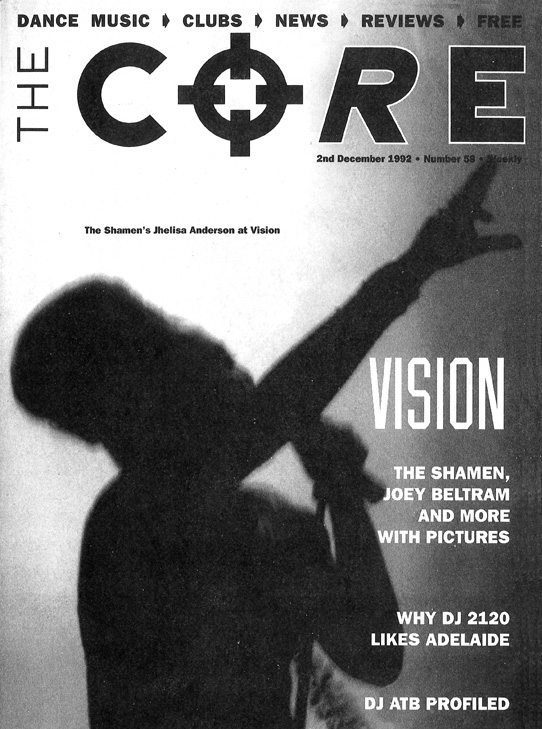
In the first week of December 1992, Adelaide’s dance music culture was a vibrant and bustling ecosystem. The city’s nightlife was defined by a packed schedule of weekly club residencies, massive one-off rave events drawing thousands, and a dynamic mix of homegrown DJs and visiting international artists shaping the sound of the scene.
Major Events and Raves
Beyond the consistent weekly club circuit, Adelaide’s scene was anchored by large-scale, high-production rave events that served as major focal points for the dance music community. These parties were ambitious in scope, often taking over unconventional venues and featuring international headliners alongside the city’s top local talent.
Vision: A Premier Rave Experience
The “Vision” brand stood as a benchmark for large-scale production in Adelaide. A review of its late November event, held on the 27th at a Hindmarsh warehouse, lauded the venue as a “perfect rave environment” with two floors and excellent views of the stage. The night featured headline performances from international acts The Shamen and Joey Beltram, with strong supporting sets from local DJs Brendon and 2120. The assessment was nuanced; while the P.A.’s DJ was described as “nothing spectacular but ‘e played proper,” the sheer power of the sound system was almost overwhelming, with the reviewer noting, “a few times I got to thinking maybe it was too much, even for a rave diehard.” Ultimately, the verdict was that it was a “brilliant night out” and a contender for the best rave the city had seen.
Building on this success, Visual Entertainment announced the brand’s next major installment: VISION “FINALE 92”. The event was scheduled for Saturday, December 19th, at the Lion Arts Centre on North Terrace, promising an all-night experience running from 10 p.m. to 7 a.m.
Dreamscape: The Magic Mountain Party
On Friday, December 4th, the “Dreamscape” party offered a uniquely immersive experience by taking over the entire Gleng’s Magic Mountain complex, transforming the “unlicensed fun park” into a dance music haven. Billed as Adelaide’s biggest dance event, it blended music and amusement, pumping ambient and progressive house through a 10KW sound system. The DJ lineup featured some of the city’s most prominent names:
- Brendon (Ark/Rave)
- Angus (Life)
- E-Zee-G (Life & Rave)
- G-Force (Rave)
- Groove Terminator (DMC Finalist)
- Chris D
What set the event apart was its extensive list of “Free Facilities,” allowing attendees to enjoy the venue’s attractions as part of the party. These included the water slide, Dodgem Cars, Sky Cycles, Bumper Boats, video games, pinball, and air hockey. The experience was supported by a hot-food court, out-door chill-out lounges, and ample car parking. Tickets were priced at $15 in advance from outlets like Central Station and Urban Streetwear, or $18 at the door.
These peak experiences were built on the foundation of a relentless, week-in-week-out club circuit that formed the true backbone and incubator of the scene.
The Weekly Club Scene
The strategic importance of regular weekly club nights cannot be overstated. These venues provided a consistent pulse for the scene, allowing different sounds and DJs to cultivate dedicated followings and providing a platform for both established and emerging talent.
Le Rox
A central hub for dance music, Le Rox offered a diverse lineup across its different spaces. Fridays featured DJs X-citement, James Ingram, and Steve Rooder. Saturdays brought in Groove Terminator and Gary Hughz, with Ian taking over the “Time Tunnel.” For those seeking a different flavor, the “Hip Hop Sound Lounge” was helmed by Madcap and Nigel. The club maintained a strict “Photo I.D Essential” policy for entry.
The Ark
The Ark dance club had a full weekend schedule. DJ Brendon held down the Friday night slot, while Saturdays featured DJs ATB and Julez. Sundays were dedicated to “THE BOUNCE,” a party showcasing a collective of talent including DJs GT, SFI, Eon, E-ccentrik, and Jawad Klip.
Proscenium (Formerly Club Foote)
On Friday, December 4th, the venue at Blyth Street hosted a special throwback event titled “THE HOUSE SOUND OF 88.” Kicking off at 10 p.m., the night was presented by Bust The House Down and featured DJs Q Deluxe (also known as Q HMC), 618, and MC Scott T. Promoter Maj promised a night dedicated to classic sounds, stating they were ready to “bust the house down with the sounds of Chicago, early acid and lots of surprises.” Admission was set at $7.
Cargo Club
The Cargo Club was home to “SWOOP” on Fridays and Saturdays, which was billed in the press as “one of the most energetic and dynamic parties,” signaling its place as a high-point in the weekly calendar. The venue also offered a full week of themed nights, including Cool, Bar, Hot, Jazz, Chic, and Bohemia, catering to a wide range of tastes.
Other Notable Venues and Nights
- Accelerate: A new night opening Thursday, December 3rd, at the Bemboka Duck in Gawler with DJ Woody. It was presented by Covin Lall, identified as “Vision’s Responsible Industry Head,” linking this new venture to the city’s premier rave brand.
- Luna: The club launched two new weekly nights in early December. Wednesdays featured DJs Therio and C-Diamond, while Sundays were for “Night trippin’ n-d-basement” with Nick & Chris.
- Martinis Reborn: A nostalgic one-off party at the Governor Hindmarsh Hotel’s Metropolis on Saturday, December 5th. Featuring “a hot DJ lineup,” it promised a trip back to the 80s complete with “sourly drunk specials, potato salad and monster plates of fried rice.”
- Black Iz Back: Held at Control Niteclub on Friday, December 11th, this event featured DJs Angus, Cutts One, and Madcap, plus a live P.A. from Finger Lickin’ Good & friends.
- Contagious The Club: A regular Thursday night party at Lennies, located at 213 Hindley St.
- The Sixty Foot Arms Party: A Friday night event on December 4th across the King’s Head and Centrals, featuring The Olive Lake Affair and visuals by Manic Visual Sustenance. The cover was $3 before 9:30 p.m. and $5 after.
These venues and events were brought to life by the individuals behind the music: the DJs themselves.
Perspectives from the Decks: DJ Spotlights
DJs were the central figures and tastemakers of the Adelaide scene. The perspectives of an international visitor impressed by the city’s energy and an emerging local talent offered contrasting but complementary views on the state of the culture.
DJ 2120 (Claude Young Jr.): An International View from Detroit
Claude Young Jr., a DJ from the techno mecca of Detroit, found Adelaide to be a surprisingly fertile ground. He was drawn to the city to find new music for his Dow record label and noted that working there was “economically feasible.” Young was particularly struck by the scale of the local rave scene, offering a direct assessment:
“It seems like every fuckin’ week there’s a ten thousand dollar production.”
He compared the burgeoning energy of Adelaide to the early Detroit scene he experienced with friends like Richie Hawtin, specifically name-checking the legendary club “The Shelter.” He observed, “It’s pretty much the same vibe as ‘The Shelter’ light, not a lot of lights… but it was pretty much the same vibe.” His endorsement of the city was emphatic, concluding with a powerful statement of intent: “I will definitely be returning for good.”
DJ ATB (Brenton Eckersley): A Local Newcomer’s Rise
Representing the new wave of local talent, Brenton Eckersley, known as DJ ATB (All Terrain Bass), had been DJing for only four months but was already making a name for himself playing Thursdays, Fridays, and Saturdays at The Ark. His musical philosophy was broad, as he explained:
“I cover all types of music – not just rave or techno.”
Despite this, he affirmed his passion for the core sounds, stating, “Basically music is my life; I love rave and techno.” When asked about the worst part of DJing, Eckersley offered a uniquely Australian insight into the cultural tensions of the time: “Because there’s always pilled out bogans and they always want to hear Jimmy Barnes and Cold Chisel and all that crap.” He predicted that while “rave and techno will die,” the movement would evolve: “dance music as a whole won’t… There will always be something there, like a natural progression of what we’ve got now.”
The work of these DJs was supported by a broader industry of music retail, media, and global distribution channels that fueled the scene.
The Music Industry Pulse
The vitality of Adelaide’s club culture was underpinned by a wider ecosystem that included record stores supplying the latest tracks, media outlets providing commentary, and crucial connections to global music trends.
New Music and Releases
Record Stores: Two key hubs for DJs and fans were Central Station on Twin Street and the Virgin Megastore in the Myer Centre. Both were vital sources for the latest UK and US imports, compilations, and merchandise. Central Station’s shelves stocked not just vinyl but also essential scene apparel, including “Nervous records bags,” “transmat caps,” and “UR long-sleeve sweaters.”
Hot Tracks and Compilations: The bins were full of fresh material. Central Station advertised new releases like Chez Damier’s “Can You Feel It” and Underground Resistance’s “The Message To The Mob.” Available compilations included “New York 9,” “Strictly Rhythm,” “Energy Rush,” “Techno Trax Co,” “Rave 92,” and “Berlin K 192.” Reviews in the local press gave high marks to new tracks, with Kenny ‘Dope’ Gonzales receiving a ****1/2 rating and hip-hop pioneer Grand Master Caz earning ****.
Scene Commentary and Media
Radio: The “Dreaming Daisies” radio show provided a dedicated broadcast platform for the scene. Aired on Tuesday nights at 10 p.m. on 93.7 Triple M, the show was hosted by a collective of scene mainstays: georgie, garage hmc, dee, and finger lickin’ good.
Letters to the Editor: Community feedback highlighted a passionate and engaged audience. Daniel Adderton, writing from a U.S. perspective, praised the local scene’s energy. A reader named Pommic Oz offered congratulations on a recent issue, while one letter writer, Wayneo-o, offered a spirited defense of the techno sound against its detractors, asking, “What do they know? Do you want to listen to commercialised art form crap? …Wake up to techno.”
Global Connections
Adelaide’s scene did not exist in a vacuum, with several local entities fostering connections to the international music world.
- DMC World Final: News arrived from the prestigious mixing championship in London, where DJ Spinnin’ “Swift” Steele from Chicago was crowned the 1992 world champion, with DJ Fakir of France as the runner-up.
- Amalgamation Distributors: This Adelaide-based group, led by Greg Ogan, was actively forging global ties. They worked to bring premier international dance labels like Rumour, Positiva, and D-Zone into the Australian market, with Ogan clarifying their broad scope: “It’s not actually techno… It’s house, garage, and even pop/dance.”
- Hollywood and Rap: On the broader cultural front, a new wave of rap-focused films was on the horizon. Upcoming movies like “Posse” and “Who’s the Man” featured prominent artists such as Busta Rhymes and Kool Moe Dee, signaling the growing mainstream influence of hip-hop culture.
Leave a Reply
You must be logged in to post a comment.