
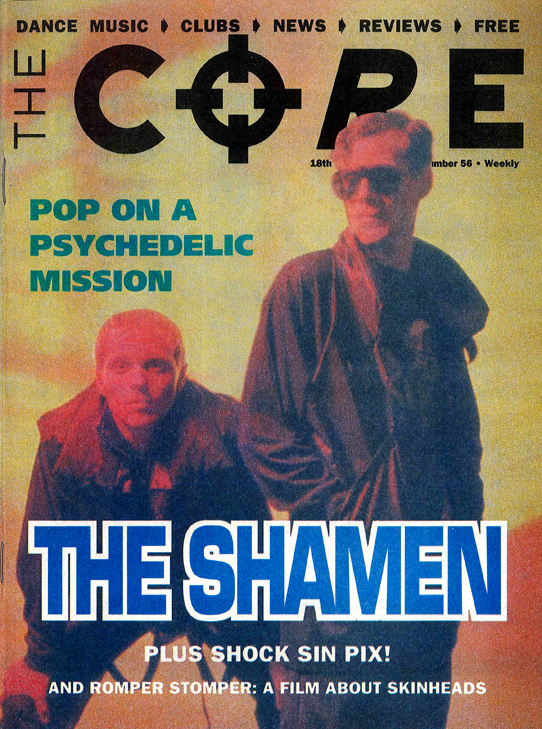
In late November 1992, Adelaide’s dance music culture was a vibrant and expanding ecosystem, buzzing with the energy of both homegrown talent and significant international tours. With global acts like The Shamen making highly anticipated appearances, the city’s scene was asserting itself as a key stop on the international circuit. The weekly street press, particularly Issue 55 of “The Core” magazine, provides a detailed chronicle of this dynamic period, capturing the clubs, sounds, and philosophies that defined a pivotal moment for electronic music in South Australia.
The Shamen’s ‘Psychedelic Mission’ Comes to Adelaide
Introduction: The Vision Festival
The centerpiece of the month was the arrival of The Shamen, headlining the Vision Dance Music Festival on Friday, 27th November. Billed as “Adelaide’s Largest Ever Dance Experience,” the festival promised “10 hrs of non stop dance music” as part of the band’s ’92 Progeny World Tour. The event featured a formidable international lineup, including New York rave DJ Joey Beltram and Detroit’s DJ 2120. They were joined by The Shamen’s own MC/DJ Mr. C—who, despite being billed on the flyer as a “Detroit Techno Supremo,” was in fact a key figure from the London acid house scene—Adelaide’s premier dance band Bliss, and a roster of the city’s top local DJs: X Citement, Hugh Z, HMC, GT, Brendon, and The System AD. Tickets were available for $25 in advance or $30 at the door, with a portion of the proceeds going to Amnesty International, cementing the event’s status as a major cultural happening.
Band Philosophy: More Than Just Pop Music
The Shamen’s appearance was more than a simple concert tour; it was the arrival of a distinct philosophy. In an interview, the band’s MC, Richard West (Mr C), defined The Shamen as an “information band” on a “pop mission with a psychedelic edge.” Their goal was not just to entertain but to educate and enlighten. “We’re catering for pop culture,” Mr C explained, “and we’re pulling people in, but we’re trying to inject totally different information to the youth… The youth of today are tomorrow’s leaders.”
This mission was deeply rooted in the concept of modern shamanism. “We’re talking about shamanism in every sense of the word,” he stated, connecting their music to a planetary consciousness and a global information network. For The Shamen, pop music was a powerful vehicle for disseminating complex ideas about psychedelics, nature, and human evolution, aiming to deliver a message that they admitted could sometimes go “slightly over their heads.”
History and Musical Evolution
The band’s sophisticated sound was the result of a long and deliberate evolution. Formed in 1986 by Colin Angus, The Shamen began as a psychedelic rock band influenced by the indie scene. The group’s trajectory shifted when Will Sin joined in 1987, and again more dramatically with a move to London in 1988, where they began collaborating with DJs and absorbing the energy of the nascent acid house movement.
Mr C, a veteran of the London acid house scene, officially joined the band in early 1991, bringing his MC and DJ skills to the forefront. This move solidified their transition into a fully-fledged dance act. Traces of this evolution can be heard in their earlier work, with their 1988 album In Gorbachev We Trust containing “proto-house” ideas that prefigured their later success with tracks like the seminal ‘Pro-Gen’.
Rave Culture, Psychedelics, and Boss Drum
The Shamen were unapologetically connected to rave culture and its psychedelic underpinnings. Mr C articulated a belief that psychedelics were fundamental to human development, positing that “the magic mushroom helped the caveman gain enough idea to become human.” However, he expressed concern over the direction of the contemporary UK rave scene, which he saw as having devolved from its “Summer of Love” ideals into a culture dominated by “speed and heroin.”
This intellectual approach culminated in their latest album, Boss Drum, which was available locally through Festival Records. A record described in the press as “esoteric, intellectual, classically processed and very psychedelic,” it featured a new “tribal” and “bog trotting element,” representing the band’s commitment to pushing musical boundaries while staying true to their core mission of enlightenment through rhythm.
Conclusion and Transition
The Shamen’s visit for the Vision festival was a landmark event, bringing a globally recognized act with a profound message to Adelaide’s doorstep. Their presence underscored the city’s growing importance, which was further evidenced by the simultaneous influx of other pioneering international DJs.
Major International DJ Tours
Introduction: A Global Influx
The arrival of several high-profile international DJs in November 1992 signaled Adelaide’s firm integration into the global dance music circuit. These tours were more than just parties; they were crucial conduits of sound and style, offering local audiences direct access to the pioneering hardcore and techno scenes of the UK and the United States.
Easygroove’s Exclusive Performance at Le Rox
On Saturday, 21st November, top-ranking British rave DJ Easygroove made his “only Adelaide performance” at Le Rox for the “Levitate” event, promising “a world class odyssey of sound vision and energy.” A pioneer of the hardcore sound with 12 years of experience, Easygroove was renowned for his unique soundscapes and technically precise mixing. The event was a marathon “10 hours of full spectrum upfront dance,” running from 9pm to 7am. The support lineup was a powerful blend of international and local talent, featuring Detroit’s DJ 2120, Adelaide’s own Groove Terminator, X-citement, and Nigel, with MC duties handled by Scott T and Easygroove himself. The club offered an accessible pricing structure, with entry at $10 before 10pm (including a free drink card), and 13 thereafter (8 for members).
Other Notable International Guests
The concentration of global talent in Adelaide during this period was remarkable. A number of other key artists were performing across the city’s top venues:
- Joey Beltram: The legendary New York rave DJ was a key drawcard for the Vision Dance Music Festival.
- MC/DJ Mr. C: In addition to his role in The Shamen, the London acid house figure was a featured artist at the Vision Festival, though local promoters billed him as a “Detroit Techno Supremo.”
- DJ 2120: The artist from Detroit was exceptionally busy, performing at the “Levitate” event at Le Rox, the massive Vision Festival, and the grand opening of The Zoo.
Conclusion and Transition
These international tours brought a surge of energy and cutting-edge sound to Adelaide, validating the local scene and inspiring its DJs and producers. This energy was channeled back into the city’s own venues, which formed the week-in, week-out backbone of a thriving and diverse club culture.
The Pulse of Adelaide’s Weekly Club Scene
Introduction: The Venues and The Vibe
Beyond the major one-off festivals and international tours, Adelaide in November 1992 boasted a remarkably dense and diverse local club scene. A network of dedicated venues hosted regular nights that catered to a wide spectrum of electronic music tastes, ensuring that every night of the week offered a unique experience for the city’s dance music faithful.
Featured Club Nights and Residencies
Fridays At The Ark Reborn
Located at 150 Glen Osmond Rd, Fullarton, The Ark Reborn was a cornerstone of the weekly scene. Its Friday night lineup featured resident DJs Dr System AD, Dr X-citement, and Nurse Brendon, with a popular “Free Before 10pm” offer drawing early crowds.
Le Rox
While hosting the massive Easygroove event on Saturday the 21st, Le Rox maintained a consistent presence with regular DJ nights throughout the week, establishing itself as a premier destination for both local and international sounds.
Club Luna
Club Luna offered a full schedule of distinct weekly events. The lineup included R.I.P on Thursdays with DJs Nigel & X-citement, Global Groove on Fridays, Homestyle on Saturdays featuring G.T.B and H.S.R, and the Chill Out Cafe to round out the weekend on Sundays.
The Zoo
A major new player arrived on the scene with The Zoo in Victoria Street, City. The club held a “VIP Industry Preview” on Thursday, November 26th, ahead of its Grand Opening. The launch featured an impressive DJ roster that included Hugh-Z, HMC, The System AD, and the visiting international heavyweight from Detroit, DJ 2120.
Proscenjum
This Blyth Street venue hosted the SUB-LEVEL event on Friday, 20th November. The night promised a deep dive into warehouse sounds with a comprehensive lineup featuring DJ Hono, Warehouse DJ’s, Xcellarate, and DJ Ashby.
Wednesdays at The Austral
For those seeking a different flavor, The Austral’s “Grooves ‘n’ Tunes” night on Wednesdays offered a mix of Hip Hop, Acid Jazz, Funk, and Rare Groove. The night was helmed by resident DJs ATB and Frankie Knuckles, showcasing the broader influences within the dance culture.
Comprehensive Gig Guide (Nov 19th – 25th)
A glance at the weekly schedule reveals the sheer depth of activity across the city’s key venues:
- The Ark Reborn: Busy all week with its “Stimulators” night on Thursday 19th (DJs A.T.B, X-citement, Brendon, and Glacia), its main event on Friday 20th, and DJ A.T.B with “The Freshest Tracks” on Saturday 21st.
- Club Luna: Offered R.I.P. on Thursday 19th, Global Groove on Friday 20th, Homestyle on Saturday 21st, and a special night with international guest 2120 and D-Mind on Sunday 22nd.
- Le Rox: Hosted DJ Ajax on Monday 23rd before gearing up for its huge Saturday night with Easygroove.
- Proscenjum: Held its “SUB-LEVEL” warehouse night on Friday 20th.
- Other Key Nights: The B B Club was active Friday and Saturday; The Britannia featured DJs on Thursday; and The Austral held its “Grooves ‘n’ Tunes” night on Wednesday 25th.
Conclusion and Transition
The packed weekly schedule demonstrates a scene with immense depth and variety, providing a fertile ground for local DJs to flourish and for audiences to explore a wide range of electronic music. This vibrant club culture was constantly fueled by a steady stream of new music and industry developments from around the globe.
Music Industry News and New Releases
Introduction: The Global Context
Adelaide’s dance scene did not exist in a vacuum; it was intimately connected to global music trends. The formation of influential new record labels, major artist developments, and emerging sounds from Europe and the US directly shaped the records that were imported, sold, and ultimately played on Adelaide’s dancefloors.
The Rise of New Record Labels
A key trend was the move by artists and rave organizers to establish their own labels to control their creative output and capitalize on the scene’s commercial explosion.
- Fantazia Records: The organizers behind the massive UK Fantazia raves launched their own record label, directed by Billy Bunter. Their strategy was to capitalize on the recent phenomenon of over 130 rave tracks entering the mainstream charts, with their first release being the compilation Fantazia: The First Case.
- SUAD Records: In a progressive move, the group Shut Up And Dance created SUAD Records, a label run exclusively for women. The venture was designed to promote female artists and producers, addressing a significant gender imbalance in the industry.
- Flying Records: The prominent Italian record label announced its expansion into the UK, signaling the increasing cross-pollination of European dance music markets.
Artist and Scene Updates
- Prince Markie Dee: The former member of the iconic hip-hop group Fat Boys launched a solo career with his new group, The Soul Convention. Teaming up with producer Cory Rooney, he also lent his production talents to rising R&B star Mary J. Blige.
- Miami’s Murk Inc.: The production duo of Ralph Falcon and Oscar G were making waves with their distinctive house sound. Their hit remix of “Funky Green Dogs From Outer Space” was a major club track, alongside a growing list of other high-profile remix projects.
- The Sugarcubes: The influential Icelandic band announced its dissolution. Rumors immediately began to circulate that former singer Bjork was already at work on a solo project with Nellee Hooper (of Soul II Soul), Jazzy B, and Kiss FM’s London jock DJ Dom T.
- European Hard House: A “new European sound” described as hard house was emerging, particularly from France with tracks like ‘Tok’. Key figures in the influential German scene included DJ Kulu, legendary electronic pioneers Kraftwerk, and ambient masters The Orb, with the club Tara in Bochum cited as a key venue.
Charts and Hot Releases
The playlists of Adelaide DJs were heavily influenced by the latest imports and releases available at specialist stores like Central Station.
TC’S PRO TEN from Central Station provided a definitive list of the top tracks of the moment:
- Child Of Slim – Always Say Ever
- Willow – Move On
- Black Traxx – Volume 3
- Cassio – Baby Love
- Yolanda – Children Of The World
- Sinamor – I Like The Way
- Erb – The Weekend
- 3rd From The Sun
- Tynspanin – One More Time
- Trance Media – Frequency Sex EP
- This Week’s Hot Releases at Central Station included must-have tracks from artists like Yolanda, DFX, Ice Cube (Predator), and TYRREL Corporation.
- Key “OUT NOW!” releases featured major LPs and singles from acts like Big Audio Dynamite II (The Globe), Bizarre Inc. (Energise), The Brand New Heavies, and Marky Mark and the Funky Bunch.
Conclusion and Transition
This constant influx of new music from the UK, US, and Europe provided the essential fuel for Adelaide’s DJs and dancefloors. The culture surrounding the scene, however, was not limited to music alone, as evidenced by the community’s shared interest in other media like film.
Film Reviews of the Month
Introduction: Beyond the Music
The culture surrounding the 1992 dance scene was multifaceted, with interests that extended beyond the club and into other forms of media. The inclusion of film reviews in a dance music publication highlights a shared audience interested in art that challenged conventions, explored complex themes, and delivered visceral experiences.
Movie Summaries
Swoon (57%) Directed by Tom Kalin, this stark black-and-white film revisits the infamous 1924 Leopold and Loeb murder case. Starring Craig Chester and Daniel Schlapp, the film offers a stylized, homoerotic take on the crime, but was critiqued for its emotionally distant and structurally rigid approach.
The Cutting Edge (68%) A classic odd-couple romantic comedy from director Paul M. Glaser. The film stars D.B. Sweeney as a disgraced, hard-partying ice hockey player who is forced to team up with a wealthy, prima donna figure skater played by Moira Kelly. The predictable but charming story follows their journey to Olympic glory.
Radio Flyer (65%) Directed by Richard Donner, this fantasy-drama stars Elijah Wood and Joseph Mazzello as two young brothers attempting to escape the grim reality of an abusive stepfather (Adam Baldwin). Their plan involves building a flying machine to break free, a premise that mixes dark subject matter with moments of childhood wonder.
Unlawful Entry (65%) This thriller from director Jonathan Kaplan stars Kurt Russell and Madeleine Stowe as a suburban couple whose lives are turned upside down by a seemingly helpful but deeply disturbed police officer, played by Ray Liotta. The film explores themes of paranoia and vulnerability as the officer’s obsession becomes increasingly dangerous.
Leave a Reply
You must be logged in to post a comment.